
 by
by API Integration for UK Businesses: Connecting Systems and Data
3 Jan, 2026Most UK businesses are drowning in data they can’t use. They have sales records in one system, inventory in another, payroll in a third, and customer support tickets scattered across three more apps. Each system speaks its own language. Without API integration, these systems stay isolated - like islands with no bridges. You’re not just losing time. You’re losing money, accuracy, and customer trust.
What API Integration Actually Does for UK Businesses
An API (Application Programming Interface) is a digital handshake between two software systems. It lets them share data automatically, without someone manually copying and pasting between screens. For a UK-based e-commerce store, that means when a customer buys a product on Shopify, the inventory drops in real time in their ERP system, the order goes to the warehouse management tool, and the shipping label prints in FedEx’s system - all without a single human typing anything.
This isn’t science fiction. It’s happening right now in small businesses across Manchester, Bristol, and Leeds. A bakery in Brighton uses API integration to sync its online orders with its accounting software. Every sale updates their profit and loss sheet instantly. No more end-of-month spreadsheet chaos. No more missed VAT entries. Just clean, accurate data flowing where it needs to go.
Why UK Businesses Are Falling Behind
A 2025 survey by the UK Digital Economy Council found that 68% of small and mid-sized businesses still rely on manual data entry between core systems. That’s not efficiency - it’s risk. Every manual entry opens the door for human error. A single typo in a product code can trigger a chain reaction: wrong stock levels, incorrect invoices, delayed shipments, angry customers.
And it’s not just about mistakes. It’s about speed. When a customer calls to check their order status, your support team shouldn’t have to log into three different platforms. With API integration, they see the full picture in one screen. That’s not a luxury. It’s a baseline expectation in 2026.
Common Systems UK Businesses Need to Connect
Most UK businesses don’t need to connect everything at once. Start with the systems that cause the most headaches:
- CRM (like HubSpot or Salesforce) - tracks customer interactions
- ERP (like Sage 50 or Microsoft Dynamics) - manages finances, inventory, and operations
- E-commerce platform (like Shopify, WooCommerce, or Amazon UK) - handles online sales
- Accounting software (like QuickBooks Online or Xero) - records income, expenses, taxes
- Payment gateways (like Stripe, PayPal, or Worldpay) - processes card payments
- Shipping and logistics (like DHL, Royal Mail, or Parcel2Go) - automates labels and tracking
- HR and payroll (like BrightHR or Clik) - syncs employee data with payroll and time tracking
These aren’t optional. They’re the backbone of your operations. If they’re not talking to each other, you’re running a business with one hand tied behind your back.

How to Start API Integration Without Overwhelming Your Team
You don’t need a team of developers. You don’t need to rewrite your entire tech stack. Start small. Pick one painful process and fix it.
Here’s how:
- Identify the bottleneck - What task takes the most time or causes the most errors? Is it invoicing? Stock updates? Customer onboarding?
- Check if your tools have APIs - Most modern platforms do. Look for ‘API documentation’ on their website. If they don’t, it’s a red flag.
- Choose a connector tool - Tools like Zapier, Make (formerly Integromat), or Power Automate let you connect systems without writing code. They offer pre-built workflows for common UK business setups.
- Test with real data - Don’t just run a demo. Use your actual customer records, orders, or invoices. See what breaks.
- Go live, then monitor - Turn it on. Watch for 48 hours. Check logs. Ask your team if anything feels off.
A London-based recruitment agency cut their candidate onboarding time from 3 days to 3 hours by linking their ATS (Applicant Tracking System) to their email platform and payroll software. No one had to retype names, addresses, or bank details. That’s the power of one well-placed integration.
Real-World Example: A UK Retailer’s 30-Day Transformation
A small fashion retailer in Birmingham had 12 different systems. Sales on Etsy, Amazon, and their own website didn’t sync. Stock was always wrong. Refunds took 7 days to process because someone had to manually update three systems. They lost 15% of repeat customers due to shipping errors.
They started with one integration: Shopify → Xero → DHL. Within 10 days:
- Stock levels updated in real time across all sales channels
- Invoices auto-generated when orders were placed
- Shipping labels printed automatically with customer details
- Refunds triggered a refund in Xero and a return label in DHL
By day 30, their order processing time dropped by 82%. Customer complaints about wrong shipments fell by 90%. Their accountant stopped screaming about mismatched ledgers.
This wasn’t expensive. They paid £120 a month for Zapier. No developers. No downtime. Just results.
What to Avoid When Integrating APIs
Many businesses make the same mistakes. Here’s how to skip them:
- Don’t integrate for the sake of it - Connecting your calendar to your CRM is cool, but if no one uses it, it’s waste.
- Don’t ignore data security - UK GDPR requires you to protect customer data. Use secure API keys. Never store passwords in connectors. Audit access monthly.
- Don’t assume ‘plug-and-play’ means ‘set-and-forget’ - APIs change. Platforms update. Your integration might break. Set up alerts for failures.
- Don’t use free tools for mission-critical workflows - Free tiers often have limits. If your order volume grows, you’ll hit a wall fast.
One Sheffield-based logistics firm used a free automation tool to connect their tracking system to their email platform. When their volume doubled, the tool stopped working. They lost 37 shipments in one week. The fix cost £2,000 - and a week of customer apologies.
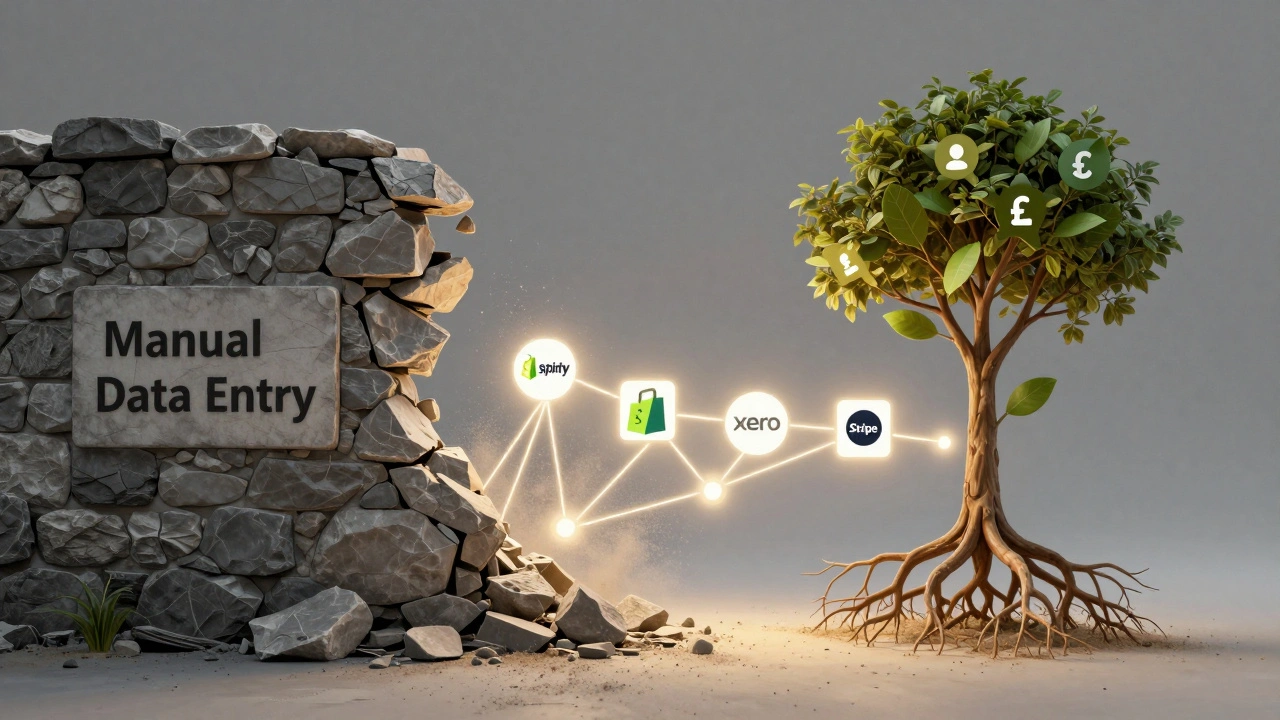
Future-Proofing Your Integration Strategy
API integration isn’t a one-time project. It’s a habit. As your business grows, you’ll add new tools. A new loyalty app. A chatbot. A warehouse robot. Each one needs to talk to the others.
Build a simple integration roadmap:
- Quarter 1 - Fix your biggest pain point
- Quarter 2 - Add one more system that impacts customer experience
- Quarter 3 - Automate reporting - connect all systems to a dashboard
- Quarter 4 - Review what’s working, what’s not, and plan for next year
Businesses that treat integration as an ongoing process grow 3.5x faster than those who treat it as a project, according to a 2025 study by TechUK.
When to Hire Help
You can start alone. But if you’re trying to connect legacy systems (like old accounting software from 2010), or need custom data transformations, you’ll need help.
Look for UK-based developers or agencies with experience in:
- RESTful APIs
- Authentication (OAuth 2.0, API keys)
- Data mapping (transforming fields between systems)
- Compliance with UK GDPR and PSD2
A good developer won’t just write code. They’ll ask: ‘What problem are you trying to solve?’ If they start talking about ‘endpoints’ and ‘payloads’ without linking it to your business goal, walk away.
Expect to pay £1,500-£5,000 for a custom integration. But if it saves your team 20 hours a week, it pays for itself in under a month.
Final Thought: Integration Isn’t About Tech - It’s About Trust
At its core, API integration is about giving your team and your customers confidence. Confidence that their order was processed. Confidence that their data is safe. Confidence that you’re not making mistakes because you’re overwhelmed.
The best technology doesn’t have the fanciest features. It just works. Quietly. Reliably. Without asking for help.
Start small. Fix one thing. Then another. And soon, you won’t just be connecting systems - you’ll be running a business that moves faster, thinks clearer, and serves customers better.
Do I need coding skills to integrate APIs for my UK business?
No. Tools like Zapier, Make, and Power Automate let you connect systems with drag-and-drop workflows. You don’t need to write a single line of code. But if you’re connecting older systems or need custom data handling, you’ll need a developer. Most small businesses start with no-code tools and upgrade only when necessary.
How much does API integration cost for a small UK business?
You can start for under £50 a month using tools like Zapier’s starter plan. For a single integration between Shopify and Xero, expect £120-£200/month for a paid tool. Custom development by a UK-based developer typically costs £1,500-£5,000 upfront. Most businesses see a return on investment within 30-60 days through time savings and fewer errors.
Is API integration secure under UK GDPR?
Yes - if done right. Always use secure authentication (API keys, OAuth), avoid storing sensitive data in connectors, and only share the minimum data needed. Use tools that are GDPR-compliant and audit your connections quarterly. Never use public Wi-Fi or unsecured networks to manage integrations.
What happens if an API breaks?
APIs can break when platforms update their software. Most integration tools send email alerts when a connection fails. Always test your workflows after major software updates. Keep a manual backup process for critical tasks until the fix is live. Don’t wait for a customer to tell you something’s broken.
Can I integrate legacy systems like old accounting software?
It’s harder, but possible. Many legacy systems don’t have modern APIs. Solutions include using middleware like Celigo or building a custom bridge with a developer. In some cases, exporting CSV files and importing them via scheduled automation is the most reliable option. If your software is over 10 years old, consider upgrading - the cost of manual work will likely exceed the price of a new system.