
 by
by Business Model Canvas for UK Startups: A Visual Strategy Guide
16 Apr, 2026The Blueprint for Your Venture
The Business Model Canvas is a strategic management tool that lets you describe, design, challenge, and pivot your business model on a single page. Think of it as a visual map that forces you to see the connection between what you're building and who is actually paying for it. Instead of guessing how your operations will work, you lay out nine building blocks that act as the skeletal structure of your company.
For a UK-based founder, this isn't just a creative exercise. With the current volatility in venture capital and the shift toward "sustainable growth" over "growth at all costs," having a lean way to visualize your strategy is the difference between scaling a viable product and burning through your seed funding on a hypothesis that was wrong from day one.
Quick Takeaways for Fast-Moving Founders
- Stop writing long plans; start mapping visual canvases.
- Focus on the "Value Proposition" first-it's the heart of the model.
- Treat your first canvas as a set of guesses, not facts.
- Use the canvas to identify gaps in your revenue streams before you launch.
Breaking Down the Nine Building Blocks
To make a Business Model Canvas work, you have to stop thinking in paragraphs and start thinking in blocks. Let's walk through the nine components, applying them to a hypothetical UK-based B2B SaaS company helping SMEs automate their VAT compliance.
1. Customer Segments
Who are you actually solving a problem for? Avoid saying "everyone." If you're targeting UK businesses, are you looking at sole traders, micro-businesses (1-9 employees), or mid-market firms? A company targeting the City of London's fintechs has a completely different customer segment than one targeting craft breweries in the Cotswolds.
2. Value Propositions
This is why customers buy from you. It's not a list of features; it's the transformation you provide. Instead of saying "We have an AI-powered VAT tool," say "We reduce the time spent on VAT returns from two days to twenty minutes." Your Value Proposition is the specific benefit that makes a customer switch from their current manual spreadsheet to your software.
3. Channels
How do you reach your customers? In the UK, this might be a mix of LinkedIn outreach, partnerships with accountancy firms, or targeted ads on Google. Consider the journey from awareness to purchase. If you're selling a high-ticket enterprise solution, your channel might be direct sales calls; if it's a £20/month app, it's likely a self-service website.
4. Customer Relationships
How do you interact with your users? Do you offer a dedicated account manager (Personal Assistance), or is it a purely automated system (Self-Service)? For UK startups, the "Customer Success" model is currently dominant, where you proactively ensure the client gets value from the tool to prevent churn.
5. Revenue Streams
How exactly does the money enter your bank account? Are you using a subscription model, a one-time licensing fee, or a freemium approach? Be specific about your pricing. For example, a tiered monthly subscription of £49, £99, and £249 based on the number of transactions processed.
6. Key Activities
What is the most important thing your company does every day to make the business work? If you're a software company, this is software development and server maintenance. If you're a consultancy, it's business analysis and client workshops. Don't list everything-only the activities that directly support your value proposition.
7. Key Resources
What assets do you need? This includes your team (developers, sales staff), your intellectual property (patents, proprietary algorithms), and your financial capital. For a UK startup, access to Seed Funding or grants from Innovate UK can be a critical resource that allows the rest of the canvas to function.
8. Key Partnerships
Who are the people outside your company that make your business stronger? This could be a partnership with an API provider like Stripe for payments, or a strategic alliance with the Federation of Small Businesses (FSB) to gain access to their members.
9. Cost Structure
Where is the money going? List your biggest expenses: AWS hosting costs, salaries for your engineering team, and marketing spend. Understand if your business is cost-driven (trying to be the cheapest) or value-driven (focusing on premium quality regardless of cost).
| Feature | Traditional Business Plan | Business Model Canvas |
|---|---|---|
| Format | Long document (20-50 pages) | Single-page visual map |
| Speed of Update | Slow (requires full rewrite) | Fast (sticky notes and markers) |
| Primary Focus | Execution and Forecasting | Hypothesis and Validation |
| Audience | Bankers and traditional investors | Founders and agile teams |
| Risk | High (builds on unproven assumptions) | Low (encourages rapid pivoting) |
From Vision to Validation: The Lean Process
The real magic of the canvas isn't in the first version you draw. The first version is just a collection of guesses. The goal is to turn those guesses into facts using the Lean Startup methodology. This means treating every block on your canvas as a hypothesis.
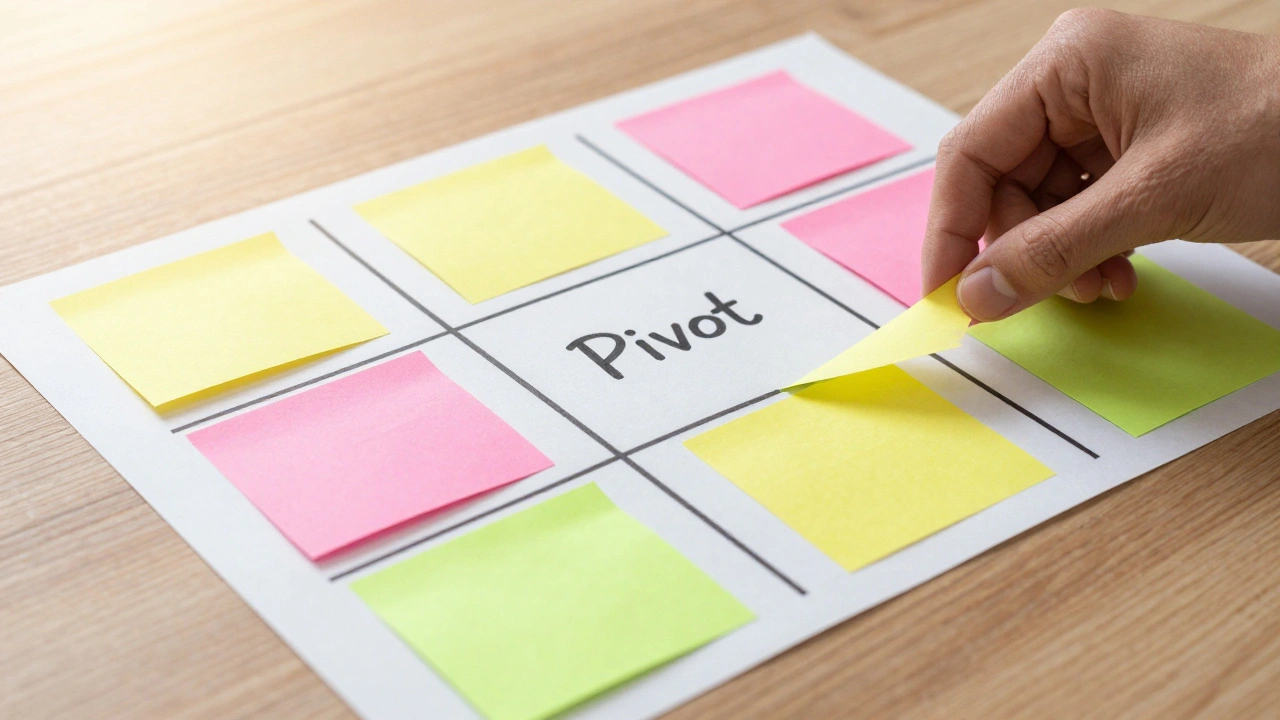
For example, if you've listed "Accountants" as your Key Partnership, don't just assume they'll want to work with you. Go talk to ten accountants in London. Ask them if they'd actually recommend your software to their clients. If they say no, you don't rewrite your entire business plan-you simply peel off the sticky note on your canvas and replace it with "Direct Marketing to SMEs." This is called pivoting, and it's the only way to survive the early stages of a startup.
One common trap UK founders fall into is focusing too much on the "Cost Structure" and "Revenue Streams" before they've actually nailed the "Value Proposition." If you don't have a product that people desperately want, the most efficient cost structure in the world won't save you. Focus on the right side of the canvas (the customer-facing side) before you obsess over the left side (the infrastructure side).
Practical Tips for Your First Session
Don't do this alone in a Word document. Get a physical printout of the canvas, grab a pack of Post-it notes, and get your co-founders in a room. Using sticky notes allows you to move ideas around and discard them without feeling the psychological pain of deleting a paragraph you spent an hour writing.
- Start with the Customer: Identify your most desperate customer first. Who has the pain point that keeps them awake at 2 AM?
- Draft the Value Prop: Write a one-sentence statement: "We help [Customer Segment] do [Task] by [Unique Method], resulting in [Specific Benefit]."
- Map the Revenue: Be honest about how you make money. Don't just say "Ads." Most UK B2B startups find more success with tiered subscriptions or performance-based fees.
- Identify the Biggest Risk: Look at your canvas. Which block, if wrong, would kill the whole business? That's your first priority for testing.

Avoiding Common Strategy Pitfalls
A frequent mistake is treating the canvas as a static document. Some teams fill it out once during their first week and never look at it again. Your canvas should be a living organism. Every time you interview a customer or launch a new feature, your canvas should change. If it hasn't changed in three months, you're either perfect (unlikely) or you've stopped learning.
Another issue is "feature creep" in the Value Proposition. Founders often try to solve five problems at once to appeal to a wider market. This dilutes your message. The most successful UK startups, like Monzo or Deliveroo, started with a very narrow, sharp value proposition and expanded only after they dominated that first niche.
Do I still need a formal business plan if I have a canvas?
Yes, but for a different reason. While the canvas is for strategy and internal alignment, a formal plan is often required by banks for loans or by some traditional UK investors for due diligence. Use the canvas to figure out what actually works, and then translate those proven insights into a formal document when the time comes.
How often should I update my Business Model Canvas?
In the early stages, you should be updating it weekly or monthly based on customer feedback. Once you achieve Product-Market Fit, updates might happen quarterly as you explore new channels or adjacent customer segments.
What if I have two different customer segments?
Don't try to cram them into one canvas. Create a separate canvas for each segment. A B2B enterprise client and a B2C individual user will have completely different value propositions, channels, and revenue streams. Trying to merge them usually leads to a confused strategy.
Which block is the most important for a UK tech startup?
The Value Proposition. Without a clear, quantifiable benefit that solves a real problem for a specific UK audience, the other eight blocks are irrelevant. You can have the best partnerships and the lowest costs, but no one will buy a product that doesn't provide a clear advantage.
Can I use the canvas for non-tech businesses?
Absolutely. Whether you're opening a coffee shop in Bristol or starting a consultancy in Edinburgh, the logic remains the same: how do you create value, deliver it, and capture a piece of that value as profit?
Next Steps for Your Strategy
If you've just finished your first draft, don't stop there. Your next move is to build a "Minimum Viable Product" (MVP) that tests the riskiest part of your canvas. If your risk is that customers won't pay £49/month, create a landing page with a "Buy Now" button and see how many people click it before you even write a single line of code.
For those looking to scale, consider exploring the "Value Proposition Canvas," which is a deeper dive into the Customer Segment and Value Proposition blocks. It helps you map exactly which "pains" you are relieving and which "gains" you are creating, making your marketing messages much more potent.