
 by
by Cross-Border Duties and Taxes for UK Online Sellers: Calculating Landed Cost
13 May, 2026Selling online across borders feels like a dream until the invoice arrives. You’ve picked your products, set up your shop, and maybe even run some ads. But then comes the reality check: landed cost. For UK-based e-commerce sellers shipping to Europe or beyond, ignoring these hidden fees isn’t just risky-it’s expensive. A customer might abandon their cart if they see unexpected charges at checkout, or worse, your goods could get stuck in customs while you pay storage fees by the day.
In 2026, the rules haven’t gotten simpler since Brexit. In fact, they’ve become more granular. If you’re not calculating exactly what it costs to move a product from your warehouse in Manchester to a doorstep in Berlin or New York, you’re leaving money on the table-or losing customers entirely. This guide breaks down how to calculate landed cost accurately so you can price correctly and keep margins healthy.
Key Takeaways
- Landed cost includes product price, shipping, insurance, duties, taxes, and handling fees-not just the item’s base price.
- Post-Brexit, all shipments from the UK to the EU are subject to customs declarations and potential import VAT.
- The HS code determines duty rates; getting it wrong can lead to delays or fines.
- IOSS (Import One-Stop Shop) simplifies VAT collection for low-value goods under €150 sent to the EU.
- Using real-time calculation tools prevents margin erosion and improves conversion rates.
What Is Landed Cost?
Landed cost is the total expense incurred to bring a product from its origin point to its final destination, ready for sale. It’s not just the wholesale price of the item. Think of it as the full journey budget: manufacturing, freight, insurance, customs duties, import taxes, brokerage fees, and last-mile delivery.
Why does this matter? Because if you only factor in the product cost and shipping, you’ll underestimate your break-even point. Imagine selling a £30 gadget. You think you make £10 profit. But once you add £5 in shipping, £4 in import VAT, £2 in handling, and £1 in currency conversion fees, that “profit” vanishes. Accurate landed cost calculation keeps your business viable.
Why Cross-Border Fees Matter for UK Sellers
Since leaving the European Union, the UK is no longer part of the single market. That means every parcel crossing into the EU is treated as an international shipment. The same applies when exporting outside Europe-to the US, Canada, Australia, or Asia. Each destination has its own tariff schedules, tax thresholds, and documentation requirements.
For example, sending a package worth €80 from London to Paris used to be seamless. Now, it requires a commercial invoice, a customs declaration form (CN22 or CN23), and possibly payment of French TVA (VAT). If the value exceeds €150, IOSS doesn’t apply, and the recipient may face additional hassle paying duties upon delivery.
These friction points directly impact customer experience. Studies show that over 70% of shoppers abandon carts when surprised by extra fees at checkout. Transparency isn’t optional anymore-it’s survival.
Components of Landed Cost
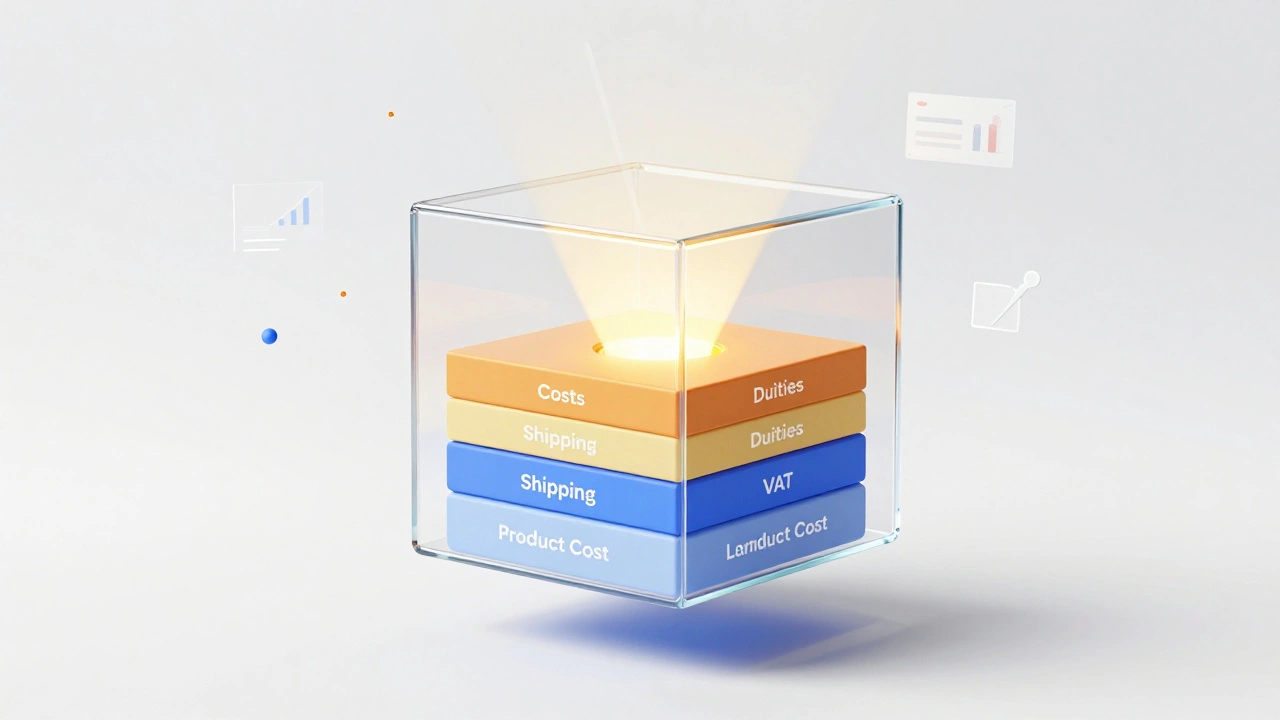
To calculate landed cost properly, break it down into five core components:
- Product Cost: What you paid your supplier per unit.
- Freight Charges: Air, sea, or ground transport fees. Includes fuel surcharges and peak season premiums.
- Insurance: Optional but recommended. Usually 0.5-1% of cargo value.
- Duties and Tariffs: Based on the Harmonized System (HS) code of the product and the importing country’s trade agreements.
- Taxes: Import VAT, GST, or sales tax depending on the destination.
Don’t forget ancillary costs like customs brokerage fees (£10-£30 per shipment), warehousing abroad, or return logistics. These often slip through the cracks but eat into profits quickly.

HS Codes and Duty Rates
The Harmonized System (HS) Code is a standardized numerical method used globally to classify traded products. Every product gets a unique 6-digit code (sometimes extended to 8-10 digits nationally). Getting this right is critical because duty rates vary wildly-even within similar categories.
Take leather handbags versus synthetic ones. A genuine leather bag might fall under HS Code 4202.31 with a 4.5% duty rate into Germany. A faux-leather version under 4202.39 could face 8%. Misclassification leads to penalties, delayed releases, or forced re-inspections.
You can find official UK export codes via HMRC’s Trade Tariff tool. For imports, consult the destination country’s customs authority-like France’s Douane Nationale or Germany’s Zollverwaltung. Many platforms now integrate automated HS lookup based on product descriptions.
VAT and Import Tax Rules
Value Added Tax (VAT) remains one of the biggest variables. In the EU, standard VAT ranges from 17% (Luxembourg) to 27% (Hungary). The UK charges 20% domestically, but exports are zero-rated unless returned unsold.
Here’s where IOSS saves time: for consignments valued under €150 going to the EU, you can register for IOSS, collect VAT at checkout, and remit it monthly through a single portal. No need for the buyer to pay separately. Above €150, however, the recipient pays VAT + duties locally-a major deterrent for impulse buyers.
Outside the EU, things differ further. The US eliminated de minimis exemptions for most goods starting January 2026 due to new anti-dumping laws. So even small packages may trigger state-level sales tax collection obligations. Always verify current thresholds before launching campaigns.
Calculating Landed Cost Step-by-Step
Let’s walk through a realistic scenario. You sell handmade ceramic mugs priced at £12 each. Shipping to Amsterdam costs £3.50 via Royal Mail International Standard. Insurance adds £0.15. The mug falls under HS Code 6911.10 (ceramic household articles), which carries a 0% duty rate in the Netherlands-but still incurs 21% Dutch VAT on the combined value of goods + shipping.
| Component | Amount (£) |
|---|---|
| Product Cost | 12.00 |
| Shipping | 3.50 |
| Insurance | 0.15 |
| Subtotal (Duty Base) | 15.65 |
| Duty (0%) | 0.00 |
| VAT (21% of £15.65) | 3.29 |
| Customs Handling Fee | 2.50 |
| Total Landed Cost | 21.49 |
If you sold the mug for £18, you’d lose money after covering fulfillment and marketing. Adjusting your retail price to £25 ensures a sustainable margin. Use spreadsheets or software plugins to automate this math across hundreds of SKUs.
Tools to Automate Landed Cost Calculation
Manual calculations don’t scale. As your catalog grows, so does complexity. Fortunately, several tools help streamline the process:
- Shopify Tax & Duties App: Integrates with carriers to estimate duties/VAT at checkout using live APIs.
- Avalara: Offers global tax compliance solutions including dynamic duty estimation.
- Zonos: Provides real-time landed cost calculators embedded in storefronts.
- EasyShip: Combines label printing with pre-calculated fee breakdowns.
Most charge monthly subscriptions (£20-£100+) plus transaction fees. But compared to lost sales or customs holds, the ROI is clear. Look for features like multi-currency support, rule-based pricing engines, and integration with your ERP system.
Common Pitfalls and How to Avoid Them
Mistakes happen. Here are the top three traps UK sellers fall into-and how to sidestep them:
- Underdeclaring Value: Trying to dodge taxes by listing lower values risks seizure, blacklisting, or criminal charges. Declare truthfully.
- Ignoring Incoterms: Terms like DDP (Delivered Duty Paid) vs. DAP (Delivered at Place) shift responsibility between seller and buyer. Choose wisely and communicate clearly.
- Failing to Update Records: Trade policies change. Stay subscribed to updates from HMRC, EU Commission, and local customs bodies.
Also consider hiring a licensed customs broker for high-volume operations. They handle paperwork, negotiate faster clearances, and advise on optimal routing strategies.
Next Steps
Start by auditing your current top 20 bestsellers. Map out their HS codes, typical destinations, and associated fees. Plug those numbers into a spreadsheet or dedicated app. Then test different pricing models-absorb some costs yourself, pass others to customers, or offer tiered shipping options.
Finally, monitor performance metrics closely. Track conversion rates, average order value, and refund reasons related to delivery issues. Refine continuously. Remember, transparency builds trust-and repeat buyers love knowing exactly what they’re paying upfront.
Do I have to pay VAT on exports from the UK?
No, exports from the UK are generally zero-rated for VAT purposes. However, you must retain proof of export (such as carrier tracking documents) to reclaim input VAT later. Failure to provide evidence may result in HMRC charging output VAT retroactively.
Can I use IOSS for shipments over €150?
No, IOSS only applies to goods valued between €0 and €150 inclusive. For higher values, the recipient must pay import VAT and any applicable duties directly to their national customs office upon delivery.
How do I determine the correct HS code for my product?
Use HMRC’s Trade Tariff Finder tool or consult your supplier’s documentation. When unsure, seek guidance from a certified customs agent. Incorrect classification can lead to fines, delays, or forced re-classification mid-transit.
What happens if my package gets held in customs?
It will incur daily storage fees until released. You’ll likely need to submit missing documentation, pay outstanding duties, or clarify misdeclared details. Proactive communication with both the carrier and local customs helps resolve issues faster.
Should I absorb duties myself or charge customers?
It depends on your brand positioning. Charging customers increases transparency but may reduce conversions. Absorbing costs boosts appeal but squeezes margins. Test both approaches via A/B experiments to see what works best for your audience.