 by
by ESG Reporting Frameworks in the UK: GRI, SASB, and ISSB Compared
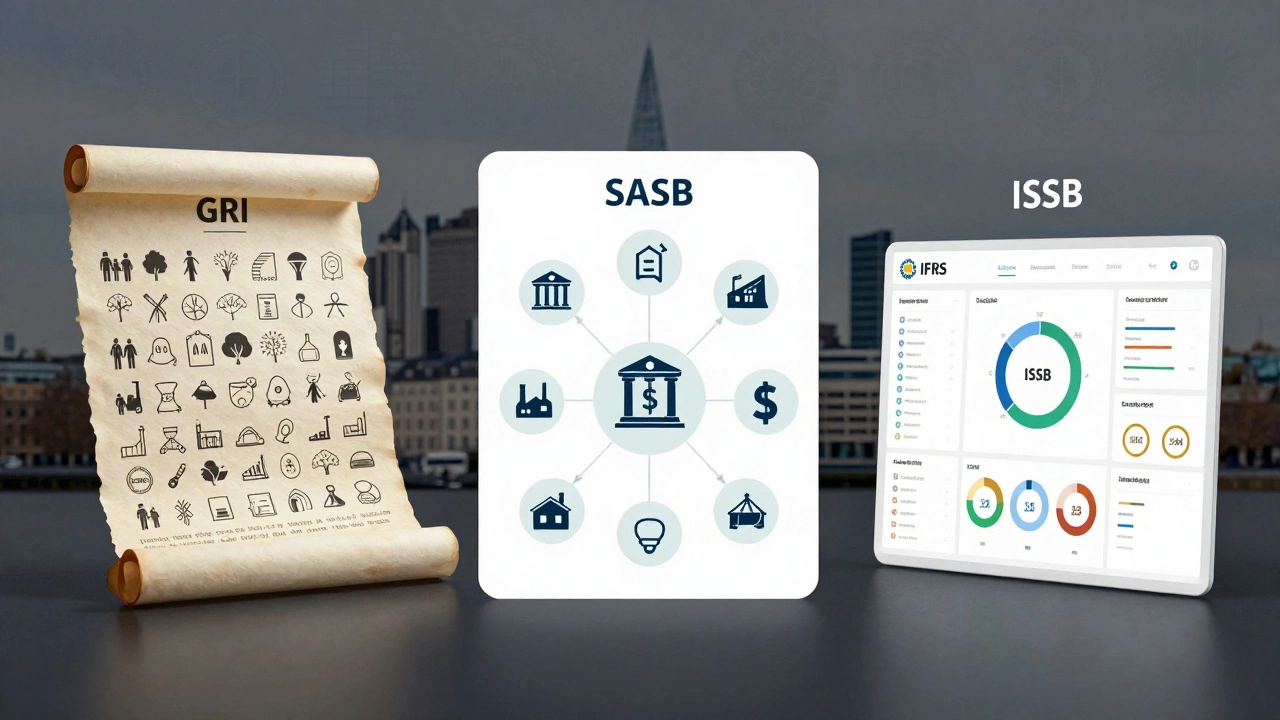
22 Feb, 2026When companies in the UK start reporting on environmental, social, and governance (ESG) factors, they don’t just pick a random template. They choose from a handful of established frameworks-each with different rules, focus areas, and expectations. The three most talked-about ones today are GRI is a global standard for sustainability reporting that helps organizations disclose their economic, environmental, and social impacts. Also known as Global Reporting Initiative, it was launched in 1997 and is used by over 15,000 organizations worldwide, including more than 80% of the UK’s largest companies., SASB is a framework focused on financially material sustainability issues that affect corporate value creation, developed by the Sustainability Accounting Standards Board. It was acquired by the International Sustainability Standards Board (ISSB) in 2022 and is now integrated into its global baseline., and ISSB is a new global standard-setter established in 2021 under the IFRS Foundation to create a comprehensive, consistent set of sustainability disclosure standards. It officially launched its first two standards-IFRS S1 and IFRS S2-in June 2023, and the UK has fully adopted them as part of its mandatory ESG reporting regime..
Why ESG Reporting Matters in the UK
The UK doesn’t just encourage ESG reporting-it now requires it. Starting in 2025, all large companies and limited liability partnerships (LLPs) with over 500 employees and £500 million in revenue must report using the ISSB standards. This isn’t optional. It’s law, backed by the Financial Reporting Council (FRC) and enforced under the Companies Act. Smaller firms aren’t exempt either; they’ll need to start preparing by 2027.
Why the rush? Investors are demanding transparency. Pension funds like the UK’s £1.3 trillion Local Government Pension Scheme now screen portfolios for ESG risks. Banks like HSBC and Barclays have stopped lending to companies that don’t disclose climate-related financial risks. And customers? They’re voting with their wallets. A 2025 YouGov survey found that 68% of UK consumers would switch brands if they found out a company hid its environmental impact.
GRI: The Broadest, Most Widely Used Framework
GRI is the grandfather of ESG reporting. It doesn’t care if your issue affects profits-it cares if it affects people and the planet. That’s why it’s used by NGOs, universities, and local councils as much as by FTSE 100 firms.
Its strength? Flexibility. GRI has over 40 topic-specific standards covering everything from biodiversity and labor rights to tax transparency and anti-corruption. Companies can pick what’s relevant. There’s no mandatory list. You report on what matters most to your stakeholders.
But here’s the catch: because GRI doesn’t tie disclosures to financial materiality, it can lead to long, dense reports that investors skip. A 2024 analysis by KPMG found that UK firms using only GRI produced reports 37% longer than those using ISSB standards. And 62% of institutional investors said they couldn’t easily compare GRI data across companies.
SASB: The Investor-Focused Approach
SASB was built by investors, for investors. It doesn’t ask, "What are your impacts?" It asks, "What sustainability issues could change your bottom line?"
For example, a UK-based textile manufacturer might report on water usage under GRI. Under SASB, it would report on water usage and how it affects regulatory compliance, supply chain costs, and brand reputation. SASB links every disclosure to financial outcomes.
It uses industry-specific standards-there are 77 of them. A bank gets different metrics than a mining company. This precision makes SASB reports shorter and more actionable. In fact, companies that used SASB before 2023 saw a 21% increase in investor engagement, according to a Harvard Business School study.
But SASB had a weakness: it didn’t cover social and governance issues well. Gender pay gaps? Board diversity? Supply chain ethics? These were often left out. That’s why it got folded into ISSB.
ISSB: The New Global Standard
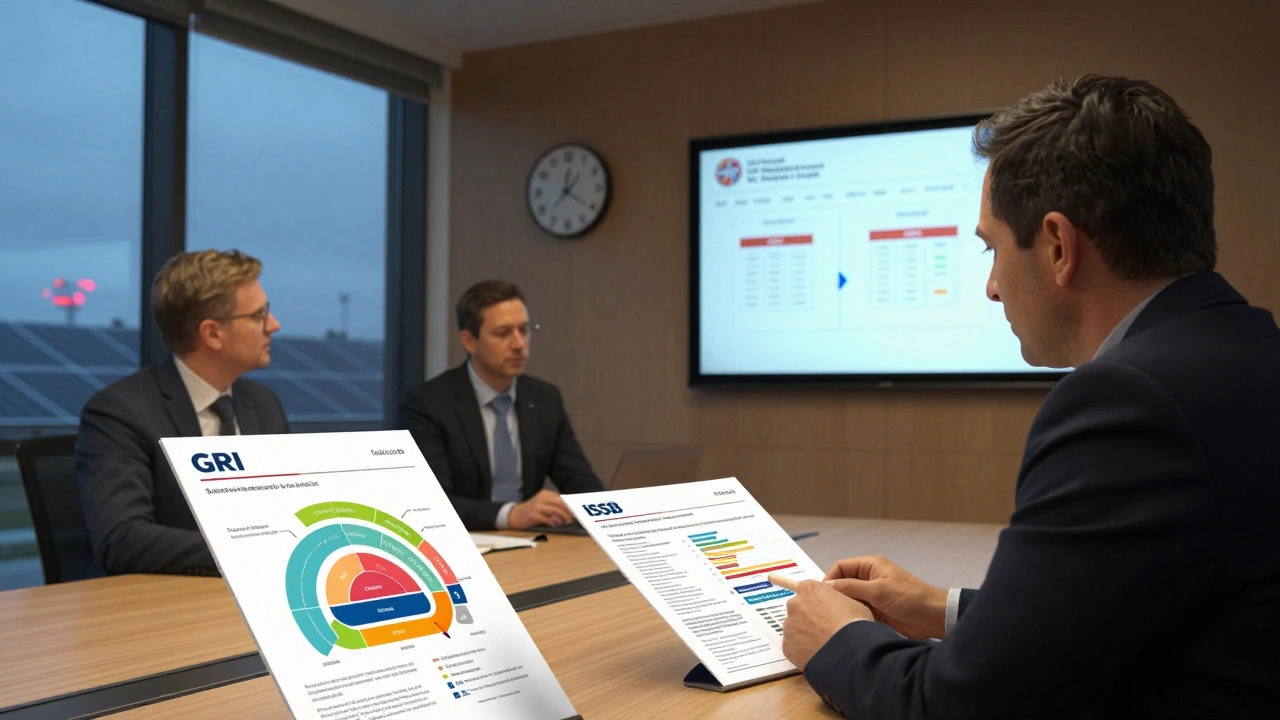
ISSB is the future-and the UK is all in. It merged the best of GRI and SASB into one unified system. ISSB S1 covers general sustainability disclosures. ISSB S2 focuses specifically on climate-related risks and opportunities.
Here’s how it works: companies must report on two things-what they impact and how it affects their financial performance. For example, a UK energy company must disclose not just its carbon emissions (impact), but also how rising carbon taxes or stranded assets could hurt its future cash flow (financial materiality).
ISSB also requires data to be auditable. You can’t just say, "We’re reducing emissions." You need to show baseline numbers, targets, and third-party verification. The UK’s FRC now requires external assurance on ISSB reports starting in 2026.
And because ISSB is based on IFRS standards, it’s compatible with financial statements. That means your ESG report can sit right next to your annual financial report. Investors don’t have to switch files. Regulators don’t have to cross-check systems.
How UK Companies Are Transitioning
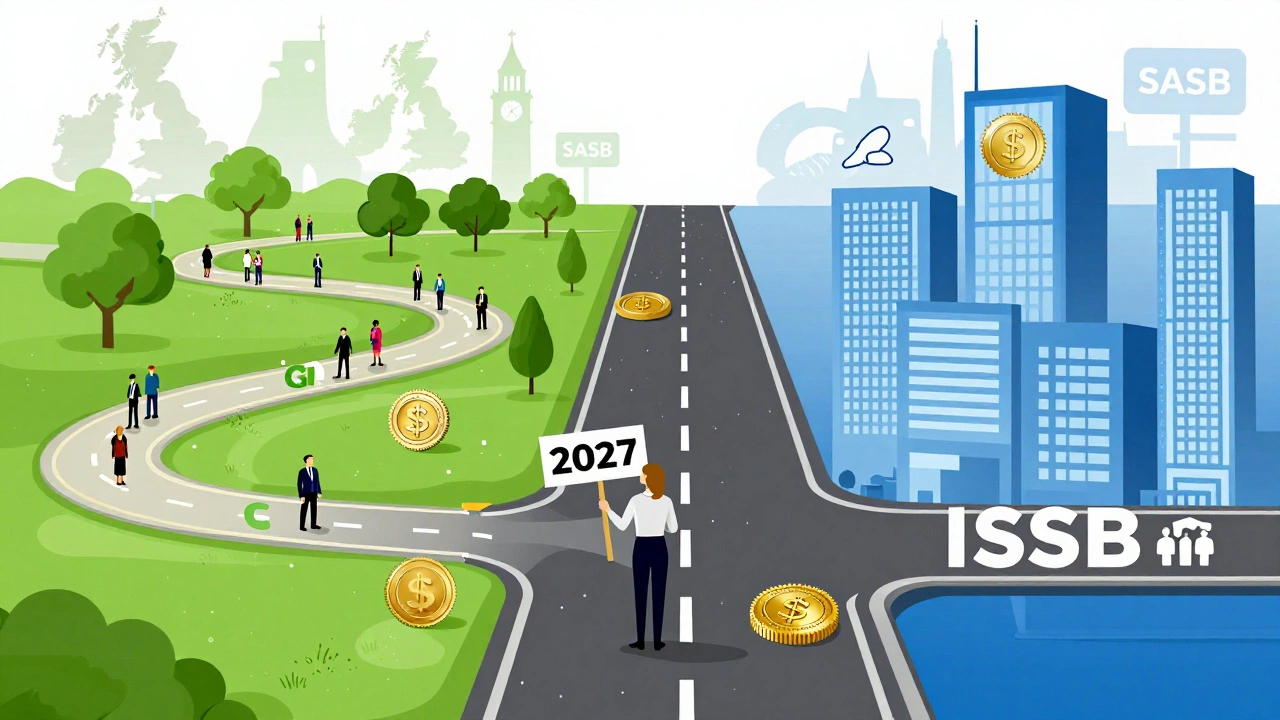
Most UK firms aren’t switching from one framework to another overnight. They’re layering. Many still file GRI reports for public-facing sustainability goals. But for investor communications, regulatory filings, and board briefings, they’re shifting to ISSB.
Take Unilever. In 2025, it published two versions of its ESG report: one using GRI for its global stakeholders and one using ISSB for its UK and EU investors. The ISSB version was 40% shorter and included only metrics tied to financial performance-like how plastic packaging costs affected supply chain resilience.
Smaller firms are struggling. A 2025 survey by the British Chambers of Commerce found that only 29% of SMEs had staff trained in ISSB reporting. The government is responding with free online training modules and a £15 million ESG support fund for small businesses.
What You Should Do Today
If you’re running a business in the UK, here’s what you need to do:
- Check if your company qualifies under the new £500 million revenue threshold.
- Start collecting data on climate-related financial risks-scope 1, 2, and 3 emissions, water stress, supply chain disruptions.
- Use the ISSB S1 and S2 standards as your baseline. Don’t wait until 2025 to start.
- Keep GRI for public communications, but don’t rely on it for compliance.
- Train your finance and compliance teams. ISSB requires accounting-level precision.
You don’t need to become an ESG expert. But you do need to understand which framework answers which question. GRI answers "What are we doing for society?" SASB answered "What affects our profits?" ISSB answers "What should investors and regulators know about our future?"
What’s Next for ESG in the UK
The UK is moving toward mandatory climate-related financial disclosures for all listed companies by 2027. That includes private equity-backed firms and subsidiaries of foreign multinationals operating in the UK.
Expect more integration. By 2028, the FRC will likely require ESG disclosures to be embedded directly into financial statements-not as appendices, but as line items. Think of it like depreciation: you don’t file it separately. It’s part of the balance sheet.
And don’t expect more frameworks. ISSB is designed to be global. The EU’s CSRD, the US SEC rules, and now the UK’s regime are all aligning with ISSB. Fragmentation is ending. Standardization is here.
Which ESG framework should UK companies use in 2026?
UK companies subject to mandatory reporting must use the ISSB standards (IFRS S1 and IFRS S2) for regulatory compliance. GRI is still useful for broader stakeholder communications, but ISSB is now the legal baseline. SASB no longer exists as a standalone framework-it’s been fully integrated into ISSB.
Is GRI still relevant in the UK?
Yes, but only for non-regulatory purposes. GRI is excellent for public sustainability reports, community engagement, and supply chain transparency. However, it doesn’t meet the UK’s legal requirement for financial materiality. Use GRI alongside ISSB-not instead of it.
What’s the difference between SASB and ISSB?
SASB focused only on financially material sustainability issues by industry, but it didn’t cover governance or social topics in depth. ISSB expanded SASB’s approach, added climate-specific standards (IFRS S2), and made all disclosures consistent with financial reporting rules. ISSB is the successor to SASB and now includes its entire methodology.
Do small businesses in the UK need to report ESG?
Not yet. Only companies with over £500 million in revenue and 500+ employees must report under the 2025 rules. But by 2027, the requirement will extend to mid-sized firms with over £100 million in revenue. Smaller businesses should still track ESG metrics-it’s becoming a competitive advantage and a supplier requirement.
Can I use GRI and ISSB together?
Yes, and many UK companies do. Use ISSB for regulatory filings and investor communications. Use GRI for public sustainability reports, CSR websites, and NGO partnerships. The data can overlap, but the framing changes: ISSB focuses on financial impact, GRI on societal impact.