
 by
by ETL vs ELT for UK Data Teams: Integration Patterns and Tools
19 Sep, 2026You’re staring at a pipeline that’s half-finished. The legacy ETL job crashed again because a source system changed its schema without telling anyone. Meanwhile, your analytics team is waiting for yesterday’s sales figures to hit the warehouse so they can prep for Monday’s board meeting. Sound familiar? For many UK data teams in 2026, this isn’t just a bad Tuesday; it’s a structural problem with how they move data.
The debate between ETL (Extract, Transform, Load) and ELT (Extract, Load, Transform) isn’t new, but the stakes have shifted dramatically. With the rise of powerful cloud warehouses like Snowflake, BigQuery, and Databricks, and stricter UK data residency requirements post-Brexit, choosing the wrong pattern doesn’t just mean slower reports-it means compliance risks and wasted budget.
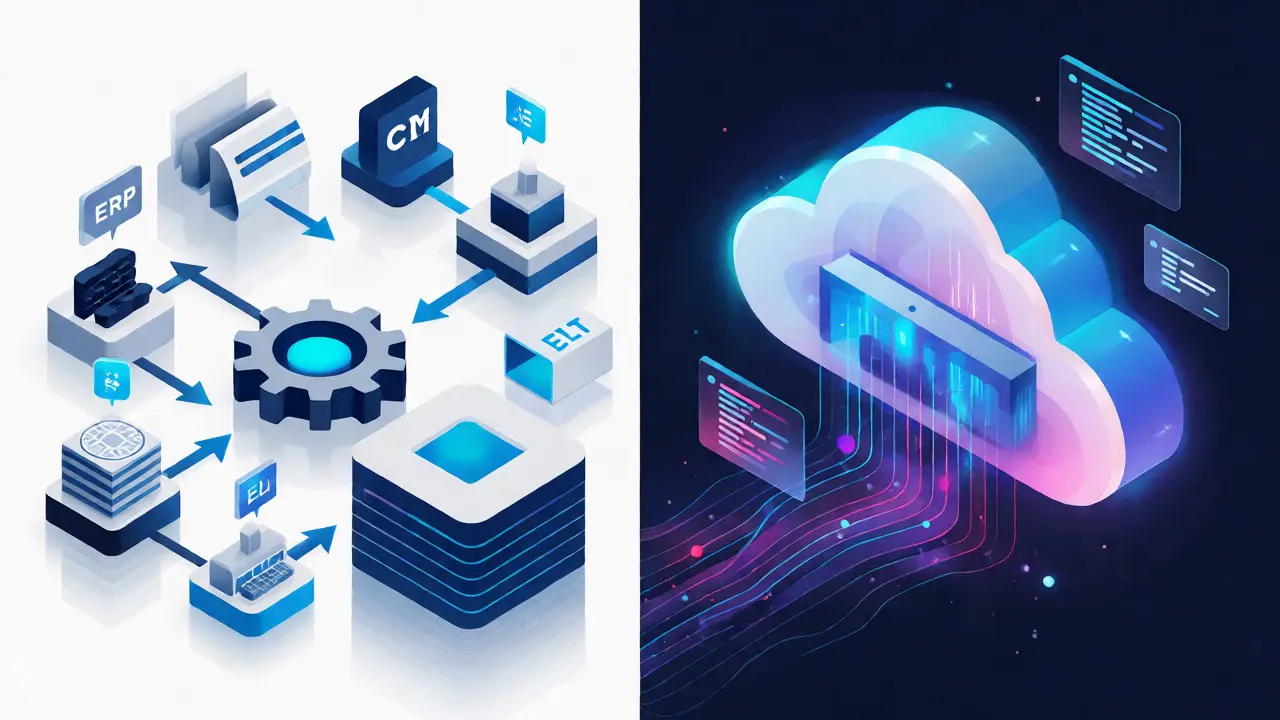
ETL is a data integration process where data is extracted from sources, transformed on a separate server or engine, and then loaded into the target database. It’s been the gold standard for decades because it keeps the warehouse clean and lightweight.
ELT, by contrast, is an approach where raw data is loaded directly into the destination system first, and transformations happen inside the warehouse using its compute power. This method leverages modern parallel processing capabilities to handle massive datasets more flexibly.
Why the Shift Happened: Cloud Compute Changes Everything
Twenty years ago, storage was expensive, and compute was cheap. That’s why ETL made sense. You cleaned data before loading it to save space. Today, storage is dirt cheap, and modern cloud warehouses offer elastic compute resources that scale up and down in seconds. If you’re still transforming data outside your warehouse, you’re likely paying twice: once for the transformation infrastructure and again for the idle time while waiting for jobs to finish.
UK companies are particularly sensitive to this shift. With GDPR and the Data Protection Act 2018 still top of mind, keeping data flows transparent and auditable is non-negotiable. ELT simplifies this by keeping raw data immutable in one place, making it easier to reprocess if regulations change or if you realize your initial transformation logic was flawed.
When ETL Still Wins: Compliance and Legacy Systems
Don’t throw out ETL just because it’s older. In specific scenarios, it remains the superior choice. If you work in highly regulated sectors like banking or healthcare within the UK, pre-loading validation is often mandatory. You might need to mask PII (Personally Identifiable Information) before data ever touches the central repository. Doing this in an ETL layer gives you granular control over exactly what enters the warehouse.
Also, consider your existing tech stack. If your organization relies heavily on on-premise Oracle databases or mainframes with limited compute capacity, pushing heavy transformation tasks onto them via ELT could bring production systems to their knees. In these cases, offloading the work to a dedicated ETL tool prevents performance bottlenecks.
- Strict Data Governance: When legal teams require data to be sanitized before storage.
- Limited Warehouse Compute: When your destination system cannot handle complex SQL transformations efficiently.
- Legacy Integrations: Connecting modern apps to older systems that don’t support JSON or semi-structured data natively.
The Case for ELT: Speed and Agility for Modern Analytics
If your goal is speed-to-insight, ELT is usually the winner. By loading raw data immediately, analysts can start querying it while transformations run in parallel. This decoupling of ingestion and preparation means you’re never blocked by a broken transformation script. If a transformation fails, you still have the raw data available for ad-hoc analysis.
For UK startups and scale-ups leveraging platforms like AWS Redshift or Azure Synapse, ELT allows for rapid iteration. Your data engineers can write SQL transformations that version-control alongside application code. This "DataOps" approach reduces the friction between engineering and analytics, a critical factor in competitive markets where decisions must be made in hours, not weeks.
Key Tools for UK Data Teams in 2026
Selecting the right tool depends on your skill set and infrastructure. Here’s how the landscape looks for UK-based teams focusing on local data residency and cost efficiency.
| Tool | Primary Model | Best For | UK Data Residency Support |
|---|---|---|---|
| Fivetran | ELT | No-code connectors for SaaS apps | Yes (AWS London region) |
| dbt | Transformation (ELT) | SQL-based modeling and testing | Runs within your warehouse |
| Airbyte | ELT | Open-source flexibility and custom connectors | Self-hosted options available |
| Informatica | ETL/ELT Hybrid | Enterprise-scale governance and legacy support | Strong UK presence |
Fivetran is a managed ELT service that automates data extraction from hundreds of sources. It’s popular among UK SMEs because it requires minimal maintenance. However, costs can spiral if you have high-volume, low-value data streams.
dbt (data build tool) transforms data directly in the warehouse using SQL. It pairs perfectly with ELT tools like Fivetran or Airbyte. For UK teams, dbt offers excellent audit trails, showing exactly who changed which model and when-a key requirement for internal compliance reviews.
Hybrid Approaches: The Realistic Middle Ground
Most mature UK data teams aren’t purely ETL or purely ELT. They use hybrid patterns. You might extract raw logs and clickstream data using ELT for immediate availability, while financial transactions go through a rigorous ETL pipeline for strict reconciliation. Recognizing that different data types have different needs saves you from forcing a square peg into a round hole.
Consider implementing a "bronze-silver-gold" architecture. Bronze is raw data (ELT). Silver is cleansed and validated (can be ETL or ELT depending on complexity). Gold is aggregated business metrics. This layered approach lets you choose the best tool for each stage without committing to a single methodology across the entire stack.

Pitfalls to Avoid for UK Organizations
One common mistake is underestimating the cost of untransformed data. Loading everything into Snowflake sounds great until you see the bill for storing petabytes of irrelevant log files. Implement lifecycle policies to archive cold data to cheaper storage tiers like S3 Glacier after 90 days.
Another trap is ignoring data lineage. In ELT, because transformations happen in SQL scripts, it’s easy to lose track of dependencies. Use tools like dbt Docs or Collibra to map out how data moves from source to dashboard. Without clear lineage, debugging a discrepancy becomes a nightmare for new hires.
Next Steps for Your Team
Start small. Pick one high-pain dataset-maybe your CRM exports-and migrate it to an ELT workflow. Measure the time saved in delivery versus the increase in warehouse compute costs. If the savings outweigh the costs, expand the pilot. Don’t rewrite your entire data platform overnight; iterate based on real-world performance data.
Is ELT always cheaper than ETL?
Not necessarily. While ELT reduces the need for separate transformation servers, it increases compute usage in your cloud warehouse. If you transform large datasets inefficiently with poor SQL queries, your warehouse bills will skyrocket. ETL can be cheaper if you have efficient, optimized transformation engines and lower volume data.
How does Brexit affect data integration choices in the UK?
Post-Brexit, UK companies must ensure personal data stays within the UK or adequate jurisdictions. Both ETL and ELT can comply, but you must verify that your chosen tools (like Fivetran or Informatica) offer UK-region hosting. Self-hosted open-source solutions like Airbyte provide maximum control over data location, which some conservative industries prefer.
Can I switch from ETL to ELT mid-project?
Yes, and many do. A gradual migration is recommended. Start by loading raw data alongside your existing ETL outputs. Once analysts trust the raw data, begin moving transformations into the warehouse using tools like dbt. Eventually, decommission the old ETL jobs. This minimizes risk during the transition.
What skills do my team need for ELT?
ELT shifts the burden from data engineers to analysts. Your team needs strong SQL skills and an understanding of dimensional modeling. Engineers still manage the ingestion pipelines, but analysts take ownership of data quality and transformation logic. Training in dbt and modern SQL practices is essential.
Which cloud provider is best for UK data residency?
All major providers (AWS, Azure, GCP) have UK regions. Azure is often favored by traditional enterprises due to its hybrid capabilities, while AWS dominates the startup scene. Choose based on your existing ecosystem rather than assuming one has better residency features-they all meet UK standards if configured correctly.