
 by
by Exporting from the UK: Your Step-by-Step Guide for First-Time Exporters
7 Nov, 2025Exporting from the UK for the first time can feel overwhelming. You’ve got a great product, maybe even a loyal customer base at home, but now you’re looking overseas and wondering where to start. The good news? The UK has one of the most supportive export ecosystems in the world. Thousands of small businesses export successfully every year - and you don’t need a big team or a massive budget to join them.
Step 1: Check if your product can be exported
Not every product can leave the UK without restrictions. Some items need special licenses, others are banned outright. Food, chemicals, medicines, weapons, and even certain types of software all have specific rules. The UK government’s Export Control Joint Unit (ECJU) manages these controls. Before you even think about shipping, go to the official export controls page and search for your product’s commodity code. If you’re unsure, use the online tool to classify your goods. It takes five minutes and could save you months of delays or fines.For example, if you’re selling handmade cosmetics, you’ll need to check if they meet EU or US cosmetic regulations. If you’re exporting machinery, you might need an export license under the UK Strategic Export Control Lists. Don’t guess - verify.
Step 2: Know your target market
You can’t just ship to everywhere and hope something sticks. Start narrow. Pick one or two countries that make sense for your product. Look at things like:- Consumer demand - are people buying similar products there?
- Cultural fit - does your brand message translate?
- Import duties - how much will your customer pay on top of your price?
- Logistics - is there reliable freight service to that country?
For many first-time exporters, starting with the EU (especially Ireland, Germany, or the Netherlands) makes sense because of proximity and similar regulations. But don’t ignore markets like Canada, Australia, or Japan - they often have lower tariffs and strong demand for British-made goods. The Department for Business and Trade (DBT) offers free market reports for over 100 countries. Use them.
Step 3: Get your UK export documentation right
Exporting isn’t just about packing a box. You need paperwork. The most common documents you’ll need:- Commercial Invoice - this isn’t just a receipt. It must include your business name and address, buyer’s details, product description, quantity, value, and HS code.
- Packing List - shows exactly what’s in each box, including weights and dimensions.
- Certificate of Origin - proves your goods were made in the UK. Often required for duty discounts under trade deals.
- Export Declaration - filed electronically through the UK’s Customs Handling of Import and Export Freight (CHIEF) system or its replacement, the Customs Service Platform (CSP).
Get these wrong and your shipment gets held at customs. Many new exporters lose weeks - and money - because they used a template from five years ago or didn’t update their HS codes. Use the UK government’s free template library or hire a customs agent for your first few shipments. It’s worth the £100-£300.
Step 4: Choose how you’ll ship
You have three main options:- Express courier (DHL, FedEx, UPS) - fastest, easiest, most expensive. Great for samples or small, high-value items.
- Freight forwarder - handles everything: pickup, customs, shipping, delivery. You pay more, but you sleep better. Ideal for shipments over 50kg.
- Direct carrier (Royal Mail, Parcelforce) - good for low-value, low-weight parcels under £135. But don’t use this for commercial exports over £135 - you’ll run into VAT issues.
For most first-time exporters, a freight forwarder is the smartest move. They know how to fill out forms, handle customs clearance, and deal with delays. Look for one with experience in your product type and target country. Ask for references. Don’t go with the cheapest quote - go with the one that explains things clearly.
Step 5: Understand VAT and taxes
This trips up almost everyone. If you’re selling to customers in the EU, you might need to register for VAT in that country once you hit a sales threshold. For the US, you don’t charge VAT, but your customer might pay import duties and sales tax. If you’re selling digital products, the rules change again.Here’s the simple rule: if you’re selling to a business (B2B), they usually handle the VAT. If you’re selling to a consumer (B2C), you may need to collect VAT at the rate of the destination country. The UK’s VAT threshold for remote sales to the EU is €10,000 per year. Once you hit that, you must register in each EU country where you exceed €35,000 in sales - or use the Import One-Stop Shop (IOSS) for goods under €150.
Use HMRC’s free online VAT calculator. It’s not perfect, but it’s better than guessing.
Step 6: Protect your payments
Never ship without getting paid. And don’t rely on bank transfers from strangers. Use secure methods:- Letter of Credit (LC) - a bank guarantees payment once you show proof of shipment. Safe but expensive and slow.
- Escrow services - platforms like Escrow.com hold payment until the buyer confirms receipt.
- Open account with credit insurance - if you’re working with a trusted buyer, you can invoice after shipping, but only if you have export credit insurance from UK Export Finance (UKEF).
UKEF offers insurance that covers non-payment due to bankruptcy, political unrest, or currency issues. It costs 0.5%-2% of the invoice value. For a £50,000 shipment, that’s £250-£1,000. It’s cheap insurance against losing everything.
Step 7: Build relationships, not just sales
Exporting isn’t a one-off transaction. It’s about trust. Customers overseas want to know they can reach you, that you’ll stand by your product, and that you understand their needs. Set up a simple email system with time-zone-friendly hours. Respond within 24 hours. Record video messages explaining how your product works in their language. Send a handwritten thank-you note with the first order.Many successful UK exporters say their biggest advantage wasn’t price - it was reliability. One London-based furniture maker started exporting to Norway with just three clients. Now, 80% of their sales are overseas. Their secret? They called every customer every three months to ask how the product was holding up.
Step 8: Use free support - you’re not alone
The UK government offers dozens of free export support services:- Department for Business and Trade (DBT) - free export advice, market reports, trade missions.
- UK Export Finance (UKEF) - insurance, loans, guarantees.
- Chambers of Commerce - local networks, export workshops, matchmaking events.
- British Chambers of Commerce Export Network - connects you with other exporters and logistics partners.
Book a free one-to-one export advice session. It’s a 45-minute call with a real expert who’s helped hundreds of businesses like yours. Don’t wait until you’re stuck - get help early.
Common mistakes first-time exporters make
- Assuming EU rules still apply exactly like before Brexit - they don’t.
- Using the wrong HS code - this can double your import duties.
- Shipping without a commercial invoice - customs will hold your goods.
- Not checking if your product needs a CE or UKCA mark.
- Trying to handle customs paperwork alone - it’s not worth the risk.
One business in Leeds exported 200 units of herbal tea to Germany - but used the wrong HS code. The buyer was charged £1,200 in unexpected duties and refused to pay. The exporter lost the sale and the product. A £20 online check could have prevented it.
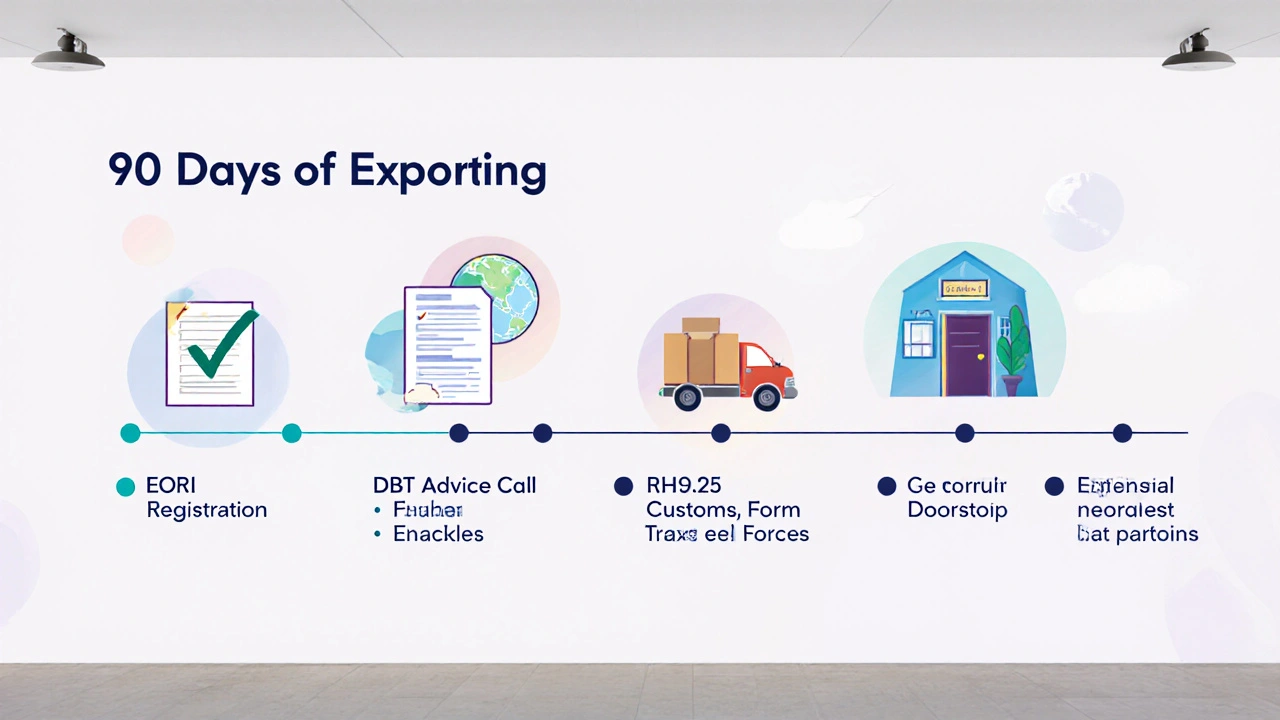
What happens next? Your first 90 days
Here’s a realistic timeline:- Week 1-2: Classify your product, check export controls.
- Week 3: Pick your first target market, download the DBT market report.
- Week 4: Draft your commercial invoice and packing list templates.
- Week 5: Contact a freight forwarder, get quotes.
- Week 6: Apply for UKEF export credit insurance if needed.
- Week 7: Book your free DBT export advice call.
- Week 8-12: Ship your first order. Track it. Ask for feedback.
By day 90, you won’t be a global giant. But you’ll have your first international sale, your paperwork sorted, and a clear path to your next one.
Do I need a special license to export from the UK?
It depends on what you’re exporting. Most everyday goods - clothing, furniture, electronics, food - don’t need a license. But if you’re exporting military items, dual-use technology, chemicals, or certain types of software, you’ll need an export license from the Export Control Joint Unit (ECJU). Always check your product’s classification first using the UK government’s online tool.
How much does it cost to export from the UK?
There’s no single answer. Small shipments under 5kg via Royal Mail might cost £15-£30. A 20kg parcel via DHL could be £80-£150. Freight for a pallet to Europe starts around £300-£600. Don’t forget hidden costs: customs clearance fees (£50-£150), export documentation help (£100-£300), and export credit insurance (0.5%-2% of shipment value). Budget at least £500 for your first shipment.
Can I export to the EU without paying tariffs?
Yes - if your product is made in the UK and meets the rules of origin. The UK-EU Trade and Cooperation Agreement allows zero tariffs on goods that are sufficiently UK-made. But you must prove it with a Certificate of Origin. If your product contains too many foreign parts, you might still pay duties. Always check the rules for your specific product category.
What’s the difference between a commercial invoice and a pro forma invoice?
A pro forma invoice is sent before the sale - it’s a quote or estimate. A commercial invoice is sent after the sale and is the official document used by customs to assess duties. Only the commercial invoice counts for legal and tax purposes. Always use the commercial invoice when shipping.
Do I need to register my business to export?
You don’t need a special export registration, but you must be a registered UK business with a Unique Taxpayer Reference (UTR). If you’re a sole trader, that’s fine. If you’re a limited company, you need your company number. You’ll also need an EORI number - this is mandatory for all exports from the UK. Get it for free from HMRC’s website.
Next steps: What to do today
Don’t wait for the perfect moment. Start now:- Go to gov.uk/export-controls and search your product.
- Get your EORI number - it takes 10 minutes online.
- Download the free DBT export guide for your target country.
- Book a free 45-minute export advice call with the Department for Business and Trade.
- Reach out to one freight forwarder - ask for a quote for your first shipment.
Exporting isn’t about being big. It’s about being prepared. The UK has the systems, the support, and the reputation. You just need to take the first step.