
 by
by Madrid Protocol for UK Businesses: How to Register Trademarks Internationally
26 Dec, 2025After Brexit, UK businesses can no longer rely on EU-wide trademark protection. If you sell products in Germany, Japan, or Brazil, your UK trademark doesn’t automatically cover those markets. That’s where the Madrid Protocol comes in - a simple, cost-effective way to protect your brand across 130+ countries with a single application.
What the Madrid Protocol Actually Does
The Madrid Protocol isn’t a new trademark. It’s a global system run by the World Intellectual Property Organization (WIPO) that lets you file one application to extend your existing UK trademark to multiple countries. Think of it like a postal service for trademarks - you send one form, pay one fee, and WIPO delivers your request to each country you pick.
Before Madrid, UK companies had to hire local lawyers in every country they wanted to protect their brand. That meant paying £2,000+ in legal fees just to file in three countries. Now, you can file for protection in 20 countries for under £1,000, depending on the classes of goods or services you cover.
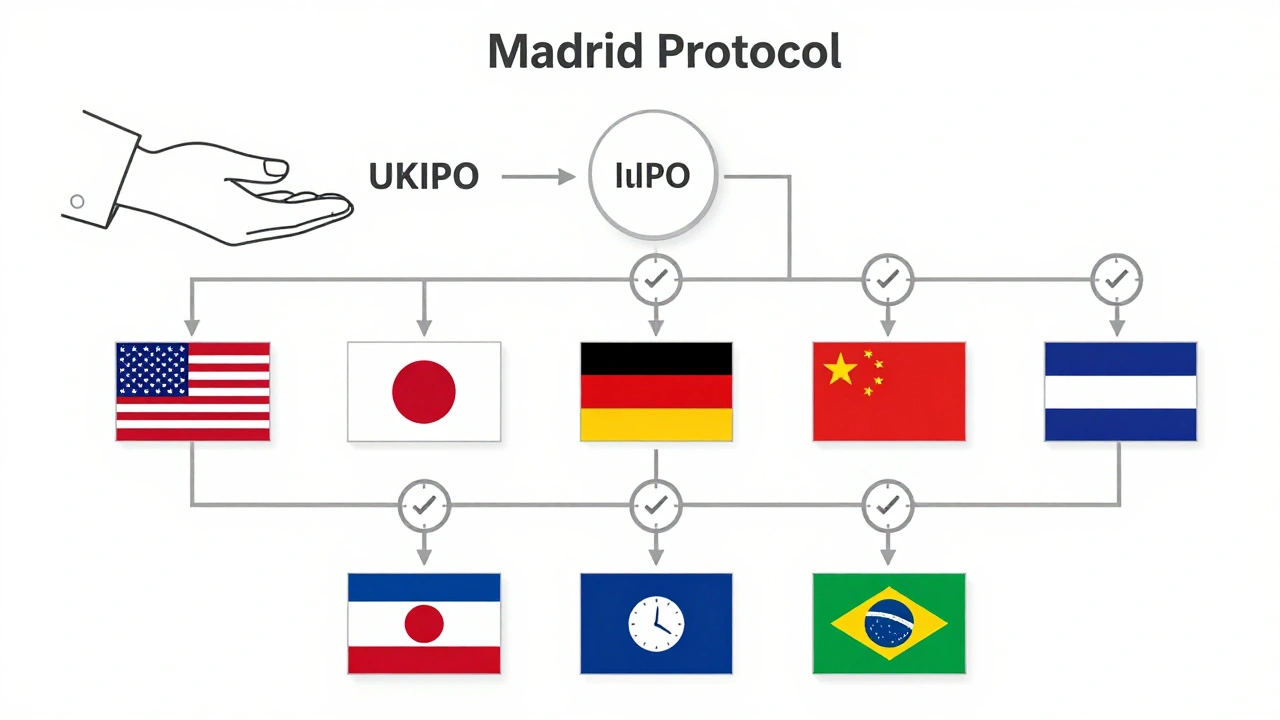
Here’s how it works: First, you must have a registered UK trademark - either with the UK Intellectual Property Office (UKIPO) or an EU trademark filed before January 1, 2021. Then, you file an international application through UKIPO. They check it, then send it to WIPO. WIPO reviews it for formalities and forwards it to each country you selected. Each country then decides independently whether to approve your trademark. That’s the key: the Madrid Protocol doesn’t guarantee approval - it just makes the process faster and cheaper.
Why UK Businesses Need It Now
Post-Brexit, UK trademarks are no longer valid in the EU. If you had an EU trademark before 2021, you got a cloned UK version automatically. But if you want to sell in France, Spain, or Italy today, you need a new EU trademark - or you can use the Madrid Protocol to cover both the EU and other countries in one go.
Take a small London-based skincare brand. They sell online to customers in Canada, Australia, and South Korea. Without international protection, someone in Seoul could register their brand name and block them from selling there. Or worse - they could sell fake versions under the same name. That’s not hypothetical. In 2023, UK businesses lost over £120 million to counterfeit goods in Asia alone, according to UKIPO reports.
The Madrid Protocol gives you a way to lock down your brand before someone else does. It’s not just for big companies. A Manchester-based coffee roaster used it to protect their name in 12 countries, including Japan and Mexico, for under £750. That’s less than the cost of one overseas trade show.
How to File Through the UKIPO
Filing under the Madrid Protocol through the UK is straightforward, but you need to follow the steps exactly.
- Have a valid UK trademark. If you don’t have one, apply first. You can’t use Madrid without a base application or registration.
- Log in to the UKIPO online system and select the Madrid Protocol option.
- Choose the countries you want to cover. You can pick any of the 130+ members - from the US to Vietnam to Chile.
- Select the classes of goods or services. Use the Nice Classification system. Most small businesses pick Class 3 (cosmetics), Class 29 (food), or Class 35 (retail services).
- Pay the fees. The base fee is £172. Then you pay additional fees per country. For example, adding the US costs £100, Japan £120, and Brazil £90.
- Submit. UKIPO reviews your application within 2-4 weeks. If it’s correct, they forward it to WIPO.
WIPO then publishes your application in the International Gazette and sends it to each country’s trademark office. Each country has 12 to 18 months to decide whether to refuse your mark. If they don’t respond, it’s approved by default.
What Countries Are Covered
The Madrid Protocol covers 130 countries, including all EU members, the US, China, Japan, Canada, Australia, Brazil, South Korea, and South Africa. You can’t cover every country - for example, Saudi Arabia and the UAE aren’t members - but you can cover 95% of global GDP with just a few selections.
Here’s a quick breakdown of the top 10 markets for UK businesses under Madrid:
| Country | Base Fee (GBP) | Approval Time | Common Refusal Reasons |
|---|---|---|---|
| United States | £100 | 12 months | Descriptive terms, similarity to existing marks |
| Japan | £120 | 12 months | Too similar to Japanese words |
| Germany | £90 | 12 months | Already registered by local company |
| France | £90 | 12 months | Offensive or misleading translations |
| Canada | £80 | 12 months | Too generic |
| Australia | £85 | 12 months | Conflict with Aboriginal terms |
| China | £100 | 18 months | Not filed in Chinese characters |
| South Korea | £110 | 12 months | Similar to Korean brand names |
| Brazil | £90 | 18 months | Already registered by distributor |
| Switzerland | £100 | 12 months | Too close to Swiss designations |
China is the most common source of refusals - not because the system is unfair, but because local companies often register foreign brand names first, especially if they’re not protected locally. Always file your trademark in Chinese characters if you’re targeting China.
Common Mistakes UK Businesses Make
Many companies think the Madrid Protocol is a magic bullet. It’s not. Here are the top three mistakes:
- Using a weak trademark - If your brand name is “Best Coffee UK,” it’s too descriptive. Most countries will refuse it. Strong trademarks are unique - like “Starbucks” or “Dyson.”
- Skipping country-specific checks - Just because the US approves your mark doesn’t mean Japan will. Some names translate poorly or have cultural meanings you didn’t know about. Test your name with native speakers before filing.
- Forgetting to renew - Madrid registrations last 10 years, but you must renew them. If you miss the deadline, your protection vanishes globally. Set calendar reminders - or hire a trademark attorney to manage renewals.
Another big error: assuming that once you file, your trademark is protected everywhere. No. Each country makes its own decision. In 2024, 23% of Madrid applications faced some form of objection in at least one country. That’s why you need to monitor your application - WIPO will notify you if a country refuses, and you have three months to respond.

Alternatives to Madrid Protocol
Is Madrid the only option? No. But it’s usually the best.
You could file directly in each country. But that means hiring 10 different lawyers, paying 10 sets of fees, and managing 10 separate deadlines. It’s expensive and messy.
You could file for an EU trademark. But since Brexit, UK businesses can’t use the EU system unless they have a business address in the EU. That means setting up a subsidiary or using an agent - adding cost and complexity.
Or you could use the African Regional Intellectual Property Organization (ARIPO) or the African Intellectual Property Organization (OAPI) for African markets. But these are regional systems - they don’t cover the US, Japan, or Australia.
For most UK businesses, Madrid is the only practical choice. It’s faster, cheaper, and simpler than any alternative.
When Not to Use Madrid Protocol
There are times when Madrid isn’t right.
If you’re only targeting one or two countries, direct filing might be cheaper. For example, if you only want to sell in the US and Canada, filing separately might cost less than using Madrid.
If your trademark is very weak or already being challenged in the UK, Madrid won’t help. The system depends on your base UK registration. If that gets canceled within five years, your international registrations fall with it - a rule called the “central attack.”
And if you’re targeting countries outside the system - like Saudi Arabia, Iran, or the UAE - you’ll need to file locally anyway.
So Madrid isn’t universal. But for 90% of UK businesses looking to expand, it’s the smartest move.
Next Steps: What to Do Today
If you’re ready to protect your brand globally:
- Check if your UK trademark is active. Go to GOV.UK’s trademark search and enter your brand name.
- Decide which countries matter most. Focus on where you’re already selling or plan to launch in the next 12 months.
- Use the UKIPO’s Madrid Protocol calculator to estimate costs. It’s free and built into their online portal.
- File your application. You can do it yourself - it takes under an hour if you have your UK trademark number ready.
- Set a reminder for renewal in 10 years. Or hire a trademark attorney for £300-£500 to manage it for you.
Don’t wait until someone else registers your brand in Brazil or Japan. The cost of filing now is tiny compared to the cost of rebranding later.
Can I use the Madrid Protocol if I’m not a UK citizen?
Yes. You don’t need to be a UK citizen. You just need to have a real business connection to the UK - like a registered office, a trading address, or a UK-based company. Sole traders with a UK business address can file too.
How long does Madrid Protocol protection last?
Each international registration lasts 10 years from the filing date. You can renew it indefinitely in 10-year increments. Renewal fees are paid directly to WIPO, and you’ll get a notice before your registration expires.
Can I add countries after I file?
No. Once you submit your application, you can’t add more countries. But you can file a new Madrid application later to cover additional countries. You’ll pay the full fee again, but you can use the same UK trademark as your base.
What happens if my UK trademark is canceled?
If your UK trademark is canceled or revoked within five years of your international registration, your Madrid protection in all countries will also be canceled. This is called the “central attack.” After five years, your international registrations become independent and can survive even if your UK trademark fails.
Do I need a lawyer to file?
No. The UKIPO allows businesses to file Madrid applications themselves. But if your trademark is complex, or you’re targeting countries with strict rules like China or the US, hiring a trademark attorney can save you from costly refusals. Many charge flat fees under £800 for the full process.