
 by
by OKRs for Scaling in the UK: Aligning Teams Around Measurable Outcomes
22 Mar, 2026When UK startups and mid-sized companies hit that awkward growth phase-where hiring slows down progress instead of speeding it up-they often ask the same question: Why are we working so hard but getting nowhere? The answer isn’t more meetings, more tools, or more managers. It’s usually a lack of alignment. Teams are pulling in different directions. Leaders are guessing what matters. And no one can point to a single number that says, "This is what success looks like." That’s where OKRs-Objectives and Key Results-come in. Not as a buzzword from Silicon Valley, but as a practical system that’s helping UK businesses scale cleanly, without chaos. Companies like Revolut, Monzo, and even older players like Just Eat Takeaway have quietly adopted OKRs to keep everyone focused when they went from 50 to 500 employees. And it’s not magic. It’s simple. It’s measurable. And it works-if you do it right.
What OKRs Actually Do for Scaling Teams
OKRs aren’t performance reviews. They’re not annual goals. They’re not spreadsheets no one reads. An Objective is a clear, inspirational direction. A Key Result is a measurable outcome that tells you whether you got there.
For example:
- Objective: Become the most trusted financial app for UK small businesses.
- Key Result 1: Increase NPS score from 32 to 58 by end of Q2.
- Key Result 2: Reduce customer support response time from 14 hours to under 4 hours.
- Key Result 3: Achieve 85% retention among SME customers who signed up in Q1.
Notice how none of these say "improve customer service" or "do better"? Those are vague. These are concrete. And they force teams to stop talking and start proving.
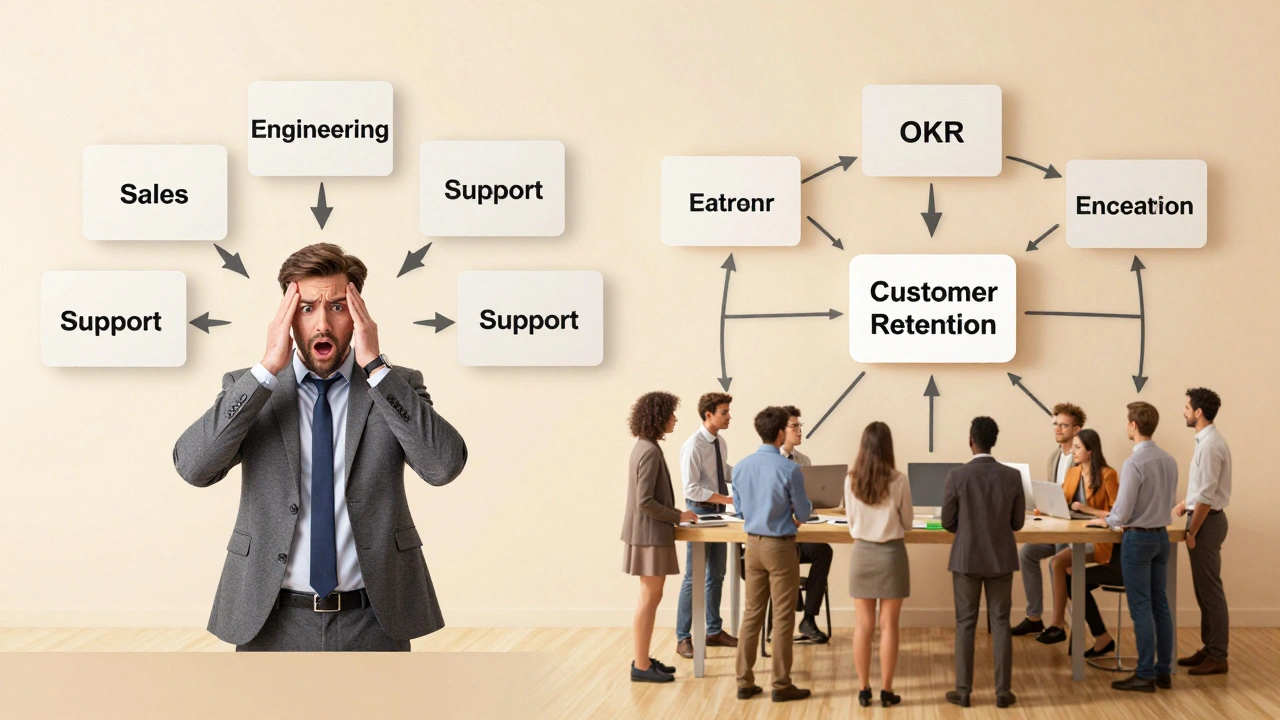
When a company scales, communication breaks down. A product team in London stops talking to the customer success team in Manchester. Engineering builds features no one asked for. Sales promises things delivery can’t deliver. OKRs fix that by tying every team’s work to one shared set of outcomes. Everyone knows what "winning" looks like-and it’s not just "hitting revenue targets."
Why UK Companies Struggle with Alignment
The UK has a unique scaling problem. Many businesses grow fast but keep old habits. Leadership still makes decisions in boardrooms. Teams operate in silos. Performance is measured by hours logged, not impact made.
A 2025 survey of 217 UK tech firms with 100-500 employees found that 68% had no cross-functional goals. Teams had their own KPIs: sales chased new logos, support chased ticket volume, engineering chased deployment speed. No one was accountable for customer retention. No one cared if the product worked for users outside London.
OKRs fix this by forcing alignment at the top. When the CEO sets one Objective for the whole company-like "Grow recurring revenue from UK SMEs by 40% in 2026"-every department has to ask: "How do we contribute?" The marketing team doesn’t just count leads. They track lead-to-customer conversion. The engineering team doesn’t just ship features. They track how many of those features are actually used by SMEs.
It’s not about control. It’s about clarity.
How to Set OKRs That Stick in the UK Market
Most OKR failures happen because they’re too ambitious, too vague, or set by one person at the top. Here’s how UK companies that succeed do it:
- Start with one company-wide Objective. Pick something that matters to your customers, not just your balance sheet. For example: "Make UK small businesses feel supported by our platform." Not "Increase revenue by 50%."
- Let teams build their own Key Results. Don’t dictate how they’ll get there. Give them the outcome, not the method. The sales team might improve onboarding calls. The product team might reduce onboarding time. Both can contribute to the same Objective.
- Set 3-5 Key Results per Objective. More than that, and you’re spreading focus too thin. Fewer than three, and you’re not measuring enough.
- Track progress weekly. Don’t wait for quarterly reviews. Use a simple dashboard-Google Sheets, Notion, or a free OKR tool like Weekdone or Ally.io-to show real-time progress. If a team’s KR is stuck, talk about it in the next stand-up.
- Celebrate effort, not just results. If a team hits 70% on a hard KR, that’s still progress. The goal isn’t perfection. It’s learning. The best teams are the ones that fail fast, adjust, and keep going.
One London-based fintech did this right. They had 120 employees. Revenue was flat. Morale was low. They set one company Objective: "Reduce customer churn among UK SMEs by 30% in six months." Each team picked their own Key Results. Customer support cut response time. Product removed three confusing steps from onboarding. Marketing ran targeted campaigns for at-risk accounts. Six months later, churn dropped 34%. No one was fired. No one got bonuses. But everyone knew why they showed up every day.
Common Mistakes UK Teams Make with OKRs
It’s easy to think you’re doing OKRs right when you’re not. Here are the top three mistakes we see:
- Mixing KPIs with OKRs. KPIs track ongoing performance: monthly revenue, website traffic, support tickets. OKRs track progress toward a bold goal. Don’t put "increase monthly revenue by 10%" as a Key Result if it’s just part of your normal business. That’s a KPI. OKRs should stretch you.
- Setting OKRs in isolation. If only the CEO sets them, they become targets, not tools. Teams disengage. Involve managers. Let engineers and support staff help shape the Key Results. Ownership drives results.
- Only reviewing them quarterly. OKRs aren’t a yearly ritual. They’re a rhythm. If you don’t check in weekly, you lose momentum. Teams drift. Goals become forgotten.
Another mistake? Using OKRs to punish. If someone misses a Key Result, don’t blame them. Ask: "What got in the way?" Maybe the tool broke. Maybe the data was wrong. Maybe another team didn’t deliver. OKRs are a diagnostic tool, not a weapon.
Tools That Actually Help UK Teams
You don’t need fancy software. But you do need something that makes progress visible.
- Google Sheets + Shared Drive: Free, simple, and works for teams that don’t want to learn new tools. Create one sheet with Objectives on the left, Key Results across the top, and % complete in each cell.
- Notion: Great for teams already using it. You can link OKRs to project boards, customer feedback, and meeting notes.
- Weekdone: A lightweight OKR tool built for small teams. Integrates with Slack and Google Calendar. Starts at £0/month for up to 10 users.
- Ally.io: For larger teams with multiple departments. Tracks dependencies between teams. Starts at £15/user/month.
One Manchester-based SaaS company switched from Excel to Weekdone. They saw a 40% increase in team engagement in just two quarters. Why? Because everyone could see what others were working on-and how it connected to the bigger picture.

What Success Looks Like After 12 Months
Companies that stick with OKRs for a full year don’t just grow faster. They grow smarter.
Here’s what changes:
- Managers stop asking "What did you do?" and start asking "What did you learn?"
- Teams stop competing for budget and start collaborating to hit shared goals.
- Onboarding gets faster-new hires know exactly how their role contributes to the company’s mission.
- Product roadmaps become customer-driven, not opinion-driven.
- Leaders stop guessing. They look at the data. And they make better calls.
One UK logistics startup scaled from 80 to 320 employees in 18 months. They didn’t hire a new VP of Operations. They didn’t buy a new ERP system. They set one Objective: "Deliver 99% of UK orders on time, every week." Every team-from warehouse staff to customer service-had a Key Result tied to it. By month 10, they hit 98.7%. Customer complaints dropped 60%. Turnover in the warehouse fell by half.
That’s the power of alignment. Not money. Not tech. Just clarity.
Where to Start Today
Don’t wait for the perfect moment. Start small. Pick one team. Pick one Objective that matters.
Here’s your 3-step plan:
- Ask your team: "If we could only achieve one thing in the next 90 days that would make the biggest difference to our customers-what would it be?" Write it down. That’s your Objective.
- Ask again: "How will we know we’ve done it?" Get three measurable outcomes. No vague language. Numbers only.
- Share it. Put it on a whiteboard. Send it in an email. Talk about it in your next meeting. Then check in every Monday.
You don’t need a consultant. You don’t need a budget. You just need to stop assuming everyone’s on the same page-and start proving it.
Scaling isn’t about hiring more people. It’s about making sure the people you have are all moving in the same direction. OKRs don’t guarantee success. But they guarantee you’ll know when you’re off track-and how to get back on.
Can OKRs work for small teams under 50 people?
Yes-and they’re even more powerful. Small teams often assume they don’t need structure. But without clear goals, they waste time on low-impact work. One team of 32 in Bristol used OKRs to cut their project delivery time by 45% in three months. They didn’t add staff. They just aligned.
Do we need to use software to implement OKRs?
No. Many UK teams start with a shared Google Sheet. The goal isn’t the tool-it’s the conversation. Software helps if you’re scaling, but clarity comes from talking, not tracking.
How often should we update our OKRs?
Quarterly is standard, but check progress weekly. If something changes-like a new competitor or a market shift-adjust your OKRs. They’re meant to be flexible, not fixed. A static OKR is a dead OKR.
What if our team disagrees on the Objective?
Good. Disagreement means people care. Don’t force consensus. Instead, ask: "Which Objective, if achieved, would create the most value for our customers?" Use data, not opinion. The team that’s closest to customers often has the clearest answer.
Can OKRs be used alongside Agile or Scrum?
Absolutely. Agile handles how you work. OKRs define what you’re working toward. A sprint goal is a mini-OKR. Your product backlog should feed into your company’s Key Results. They’re complementary, not competing.
Next Steps for UK Teams
If you’re thinking about OKRs, don’t wait for "the right time." The best time was yesterday. The second best is now.
Start with one team. Pick one Objective. Define three measurable outcomes. Share it. Track it. Talk about it. And watch what happens when everyone finally knows what winning looks like.