
 by
by Organisational Structure for UK SMEs: How to Design Teams That Actually Work
16 Jan, 2026Most UK small and medium-sized enterprises don’t fail because of bad products or lack of customers. They fail because their teams don’t work together. A messy organisational structure turns good people into frustrated workers, slows down decisions, and kills innovation. If your team feels like a puzzle with missing pieces, it’s not because they’re lazy. It’s because the structure doesn’t fit the work.
Why Structure Matters More Than You Think
In a UK SME with 15 to 100 employees, the way you group people isn’t just an HR formality. It’s the hidden engine of your business. A startup with five people can get away with everyone doing everything. But once you hit 20 staff, roles start to blur. Who approves budgets? Who handles customer complaints? Who reports to whom? Without clear answers, you get duplicated work, blame games, and slow progress.
Look at the data: according to the Federation of Small Businesses (FSB), 68% of UK SMEs with over 50 employees say communication breakdowns are their biggest internal challenge. That’s not about personality clashes. That’s about structure. When your team doesn’t know where to go for answers, they stop asking. And that’s when problems grow.
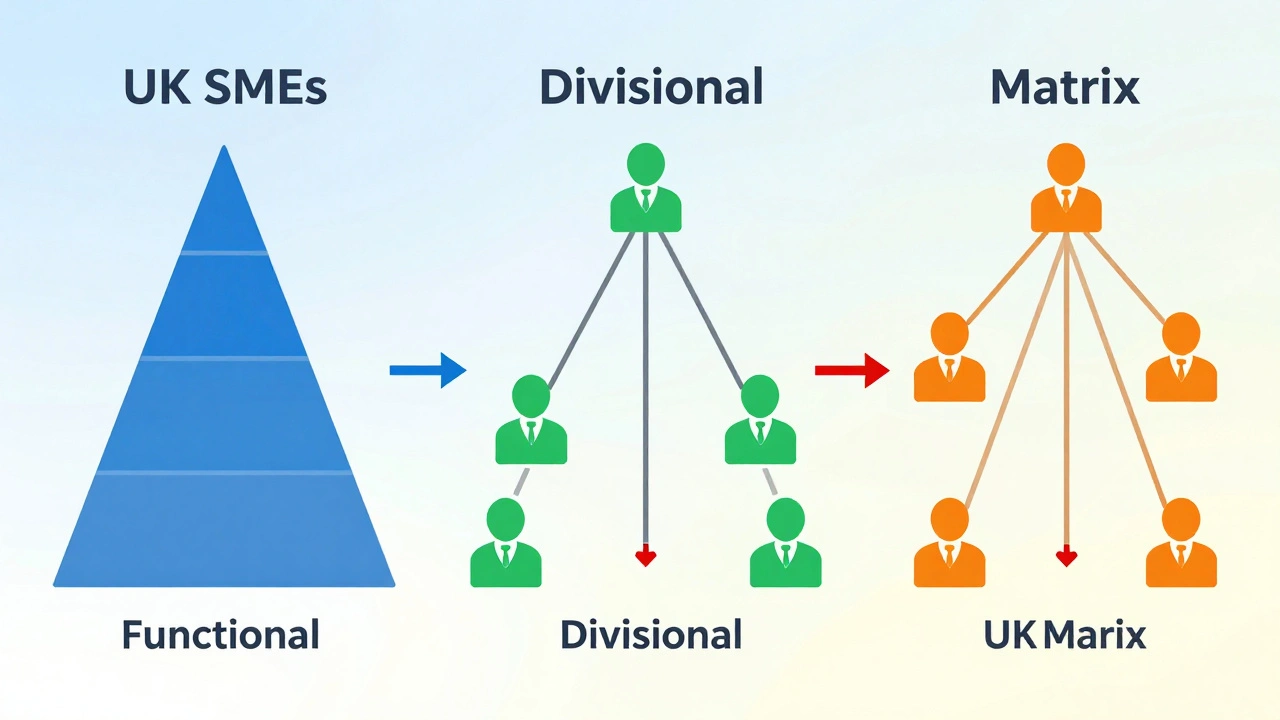
The Three Most Common Structures for UK SMEs
There’s no one-size-fits-all. But three models work best for most small businesses in the UK.
- Functional Structure: Teams are grouped by what they do - sales, marketing, operations, finance. This works well if your business runs on repeatable processes. Think of a local bakery with a head baker, a sales lead, and a bookkeeper. Clear lines. Easy to manage. But it can create silos. The sales team might promise delivery times the kitchen can’t meet.
- Divisional Structure: Teams are grouped by product, customer type, or location. Useful if you serve different markets. For example, a UK-based manufacturing SME might have one team for B2B clients and another for retail customers. Each team has its own sales, support, and logistics. This gives agility but can be expensive to duplicate roles.
- Matrix Structure: People report to two bosses - one by function, one by project. Common in tech or consulting firms. A project manager might lead a product launch, but the team members still report to their department heads. It’s flexible but confusing. People get pulled in too many directions. Only use this if your team is experienced and you have strong leadership.
Most UK SMEs start with functional. As they grow, they drift into divisional. Matrix? Only if you’re already running multiple complex projects and have managers who can handle the complexity.
Designing Teams Around Outcomes, Not Titles
Stop designing teams around job titles. Start designing them around outcomes.
What’s the one thing your business needs to get better at this year? Faster delivery? Higher customer retention? Lower overhead? Pick one. Then build a team around it.
For example, if you want to cut delivery times by 30%, don’t just assign it to logistics. Create a cross-functional team: one person from warehouse, one from sales, one from IT (to fix the tracking system), and one from finance (to track costs). Give them a deadline. Give them authority to make small decisions. Let them own the outcome.
This approach works because it cuts through hierarchy. In a traditional setup, a warehouse worker might see a delivery delay and think, “That’s not my problem - sales promised the date.” In an outcome-based team, everyone shares the goal. They fix it together.
How Many Layers Should You Have?
Every extra layer between the front-line worker and the boss slows things down. For a UK SME with 50 employees, three layers is the sweet spot.
- Layer 1: Front-line staff (sales reps, technicians, customer service)
- Layer 2: Team leads or department managers
- Layer 3: CEO or managing director
That’s it. If you add a “head of operations” between the manager and the CEO, you’ve added a bottleneck. That person becomes a gatekeeper. Decisions take longer. Information gets filtered. People stop speaking up.
One UK-based digital agency with 60 staff tried adding a “Director of Client Services” to handle growth. Within six months, client feedback scores dropped. Why? The director was approving every client change request. The team stopped taking initiative. They waited for permission. The CEO had to remove the role. They went back to two layers. Client satisfaction went up 22% in three months.
Clear Roles, Not Just Job Descriptions
A job description says what someone does. A clear role says what they’re responsible for - and what they’re not.
For example:
- Marketing Manager: Owns lead generation targets. Runs campaigns. Manages the agency. Does not handle customer onboarding or invoice follow-ups.
- Operations Lead: Owns delivery timelines, inventory levels, and supplier contracts. Does not approve marketing spend or hire sales staff.
Write these down. Put them on the wall. Review them every quarter. If someone is doing work outside their role, ask why. Are they bored? Overworked? Is the structure broken?
One Sheffield-based printing firm had their bookkeeper handling customer complaints because no one else would. The bookkeeper was great with numbers, terrible with angry clients. They hired a customer success lead. Complaints dropped 40%. The bookkeeper got back to doing what they were good at.
What Your Team Structure Shouldn’t Look Like
Here are three mistakes UK SMEs make over and over:
- The Founder’s Shadow: The owner still approves every invoice, hires every new person, and signs off on every email. You’re not leading - you’re micromanaging. This kills growth. If you’re the bottleneck, you’re the problem.
- The Flat Lie: “We’re all equals here!” sounds nice. But when there’s no clear leader, decisions stall. Who picks the vendor? Who fires the underperformer? Without structure, you get silence - and resentment.
- The Copy-Paste Structure: You saw how a tech startup in London organises their team. You copy it. But your business doesn’t sell SaaS. You fix boilers. Your work is different. Your structure should be too.

How to Test If Your Structure Is Working
Ask these three questions every six months:
- How long does it take to make a simple decision? If it takes more than three days to approve a £500 expense, your structure is broken.
- Do people know who to go to when they’re stuck? If more than one person says, “I don’t know who to ask,” your roles aren’t clear.
- Are you hiring for skills or for titles? Are you bringing in a “Sales Executive” because that’s the title you’ve always used - or because you need someone who can build client relationships?
If you answer “no” to any of these, it’s time to redesign.
Next Steps: Build Your Structure in 30 Days
Here’s how to fix your team structure without chaos:
- Week 1: Map your work. List every task your team does. Group them by outcome (e.g., “Get new customers,” “Deliver products on time”).
- Week 2: Assign owners. For each outcome, pick one person responsible. Not a team. One person. If no one owns it, create a new role.
- Week 3: Cut the fluff. Remove any role that doesn’t directly support a key outcome. If someone spends more than 20% of their time on tasks that aren’t theirs, fix the structure, not the person.
- Week 4: Communicate and test. Show everyone the new structure. Let them ask questions. Give it 30 days. Then check in. Did decisions get faster? Did people feel clearer?
Don’t wait for a crisis. Redesigning your team structure isn’t a one-time project. It’s part of running a business. As you grow, your structure must grow with you. The goal isn’t perfection. It’s progress. One clear role at a time.
Frequently Asked Questions
What’s the best organisational structure for a UK SME with fewer than 20 employees?
For teams under 20, keep it simple: one leader, and everyone else as individual contributors with clear responsibilities. Avoid layers. Let the owner handle most decisions - but only if they’re not slowing things down. Focus on defining who owns what outcome, not on titles. A salesperson should know they’re responsible for hitting monthly targets, not just taking orders.
Can I have a flat structure and still be successful?
Yes - but only if you have strong leadership and clear decision rules. Flat doesn’t mean no leadership. It means leadership is shared. You need someone who can step in when there’s disagreement. Without that, teams stall. Most UK SMEs that try flat structures end up with silent conflicts because no one knows who has the final say. If you go flat, name your decision-makers upfront.
How do I know if I’m micromanaging because of poor structure?
If you’re the only person who can approve spending, hire staff, or change a process, you’re the bottleneck. If your team waits for your email before acting, your structure is broken. Good structure gives people authority to act within their role. If you’re constantly fixing things others could handle, it’s not that they’re lazy - it’s that you haven’t given them the space to lead.
Should I hire a consultant to design my team structure?
Only if you’re stuck and don’t know where to start. Most UK SMEs can fix their structure themselves by asking the right questions. Consultants are expensive and often suggest generic models that don’t fit your business. Try the 30-day plan first. If you’re still confused after that, then bring in someone who’s worked with businesses like yours - not just big corporations.
How often should I review my organisational structure?
Every six months. If you’ve added a new service, hired more than five people, or lost a key team member, review it immediately. Structure isn’t set in stone. It’s a living system. What worked when you had 10 people won’t work at 40. Regular check-ins prevent small problems from becoming big ones.