
 by
by Production Planning in the UK: Master Forecasting and Scheduling for On-Time Delivery
4 Apr, 2026Here is the quick breakdown of how to stabilize your output:
- Move from reactive guessing to data-driven demand forecasting.
- Sync your master production schedule (MPS) with real-time machine capacity.
- Implement a 'pull' system to stop overproducing slow-moving parts.
- Build a buffer for the inevitable UK supply chain hiccups.
The Forecasting Gap: Why Your Numbers Are Always Slightly Off
Forecasting isn't about predicting the future perfectly-that's impossible. It's about reducing the margin of error. In the UK, many firms still rely on 'last year plus 5%' logic. But with shifting energy costs and volatile import-export timings, that approach is a recipe for stockouts or bloated warehouses.
To get it right, you need to use Demand Forecasting is the process of estimating future customer demand using historical data, market trends, and statistical models. Instead of one big number, break it down by product family. If you're making automotive components, don't just forecast 'parts'; forecast by chassis type or engine spec. This allows you to spot if one specific line is spiking while others are dormant, preventing you from wasting capacity on the wrong items.
A common mistake is ignoring the 'bullwhip effect.' This happens when a small change in consumer demand causes massive swings in orders for raw materials. To stop this, talk to your customers. A quick weekly sync with your top three clients can reveal a shift in their order patterns long before it hits your ERP system. When you align your forecast with actual market intent, you stop treating your warehouse like a guessing game.
Building a Master Production Schedule That Actually Works
Once you have a forecast, you need a plan. This is where the Master Production Schedule is a centralized document that specifies what the company expects to produce in each time period, acting as the bridge between sales and operations, or MPS, comes in. Many managers treat the MPS as a static document, but in a real factory, things break and people get sick.
Your MPS should be built on 'Available-to-Promise' (ATP) logic. This means you don't promise a delivery date based on hope, but on actual capacity minus already committed orders. If your CNC machine can run 100 hours a week and you've already booked 80, you only have 20 hours of 'real' time. Promising 30 hours of work for that week is how you end up with angry customers and a stressed-out crew.
To keep this fluid, use a rolling horizon. Plan the next two weeks in high detail (down to the hour), the following four weeks in daily chunks, and the rest of the quarter in weekly blocks. This prevents you from over-committing in the short term while still giving your procurement team enough lead time to order materials from overseas.
Scheduling for the Shop Floor: Tactics to Kill Bottlenecks
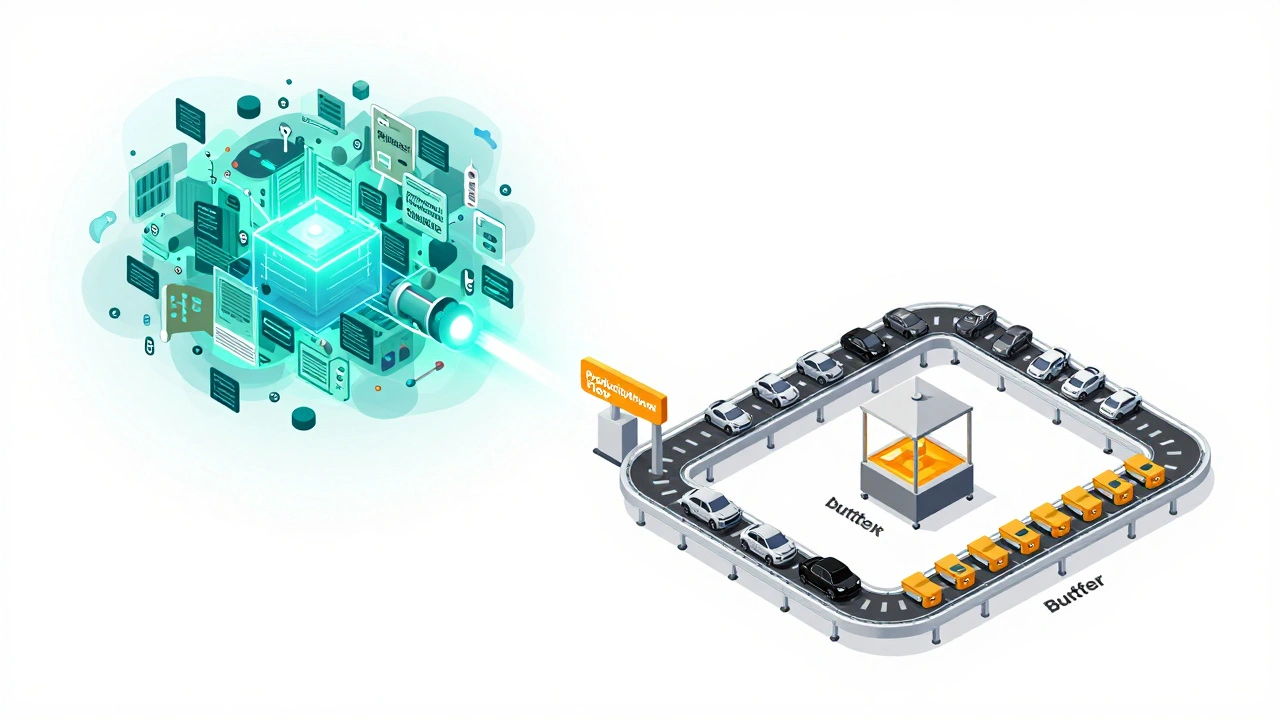
If the MPS is the map, Production Scheduling is the detailed allocation of resources, machinery, and labor to specific tasks over a set timeframe to optimize throughput is the turn-by-turn navigation. This is where the rubber meets the road. The biggest killer of on-time delivery is the 'bottleneck'-that one machine or process that everything else has to wait for.
Identify your constraint using the Theory of Constraints. If your assembly line can do 50 units an hour but your painting booth can only do 20, your assembly speed is irrelevant. You are a 20-unit-per-hour factory. To fix this, don't just buy a second painting booth; optimize the one you have. Ensure the painters never wait for a part to arrive. Move the 'buffer' of work right in front of the painting booth so the machine never runs dry.
Consider using a Kanban is a lean manufacturing tool using visual signals to trigger the movement of parts or the start of production based on actual consumption system. Instead of pushing parts through the factory based on a schedule, let the next station 'pull' them when they're ready. This prevents the 'pile-up' of half-finished goods that clutter the floor and hide quality issues until it's too late to fix them.
Managing the UK Supply Chain Chaos
Planning in the UK requires a specific kind of resilience. Between port delays and fluctuating fuel prices, your internal schedule is only as good as your external inputs. Relying on 'Just-in-Time' (JIT) delivery is a great way to keep lean, but it's also a great way to shut down your entire line because a truck is stuck on the M6.
Switch to 'Just-in-Case' for your critical, long-lead components. Identify your 'A-category' items-the parts you can't build without. Increase your safety stock for these specific items while keeping the rest of your inventory lean. This strategic buffering means a two-day delay at a shipping terminal doesn't turn into a two-week delay for your customer.
Build a tiered supplier network. Having a primary supplier in East Asia is fine for cost, but having a secondary, local UK supplier for emergency batches is a lifesaver. You might pay a premium for the local part, but that's significantly cheaper than paying a late-delivery penalty or losing a long-term contract.
| Strategy | Best For... | Main Risk | Impact on Delivery |
|---|---|---|---|
| Push System | High-volume, standard products | Excess Inventory | Fast for stock items, slow for custom |
| Pull System (Kanban) | Custom or varied product mixes | Stockouts if demand spikes | Highly reliable on-time delivery |
| JIT (Just-in-Time) | Low-margin, high-efficiency needs | Supply chain fragility | Risky in volatile markets |
| Strategic Buffering | High-value, critical components | Higher holding costs | Protects against external shocks |
The Tech Stack: Moving Beyond the Spreadsheet
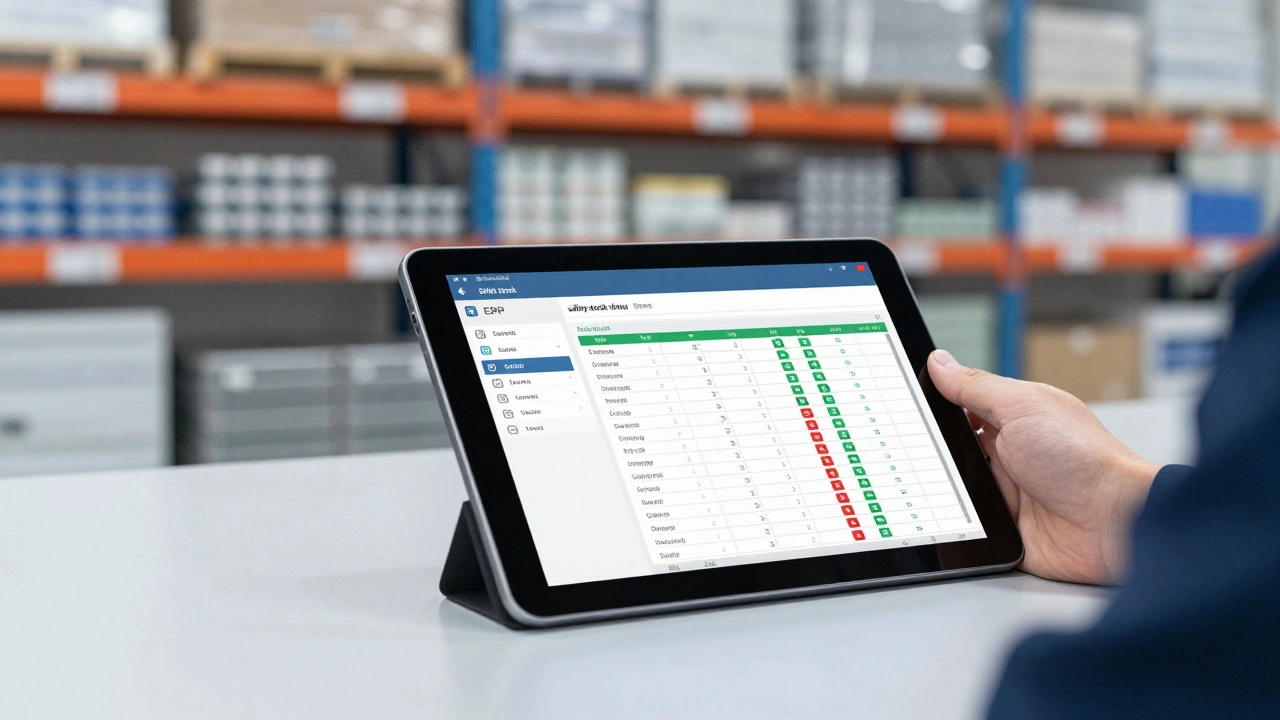
If you're still running your entire factory on a single Excel sheet, you aren't planning; you're recording history. Spreadsheets are where data goes to die because they don't update in real-time. To scale, you need ERP Systems is Enterprise Resource Planning software that integrates all facets of an operation, including production, inventory, and sales, into a single database.
A modern ERP allows you to perform 'what-if' analysis. What happens if the order for 5,000 units arrives two weeks early? What happens if Machine 3 goes down for 48 hours? Instead of spending three hours recalculating cells in a workbook, a proper system can reshuffle the schedule in seconds. This agility is what separates a company that survives from one that thrives.
Integrate your ERP with shop-floor data collection. Use tablets or scanners at each workstation so you know exactly where a job is in the process. When a worker marks a task as 'complete,' the scheduler should update instantly. This removes the 'I thought it was done' conversations and gives you a true picture of your on-time delivery performance.
What is the ideal safety stock level for UK manufacturing?
There is no single number, but a good rule of thumb is to calculate the average lead time and multiply it by the standard deviation of demand. For critical components coming from overseas, many UK firms now maintain 4-8 weeks of buffer, whereas local parts are kept at 1-2 weeks. The goal is to cover the longest possible delay you can realistically expect from your supplier.
How do I handle sudden 'rush' orders without ruining the whole schedule?
Build 'capacity pockets' into your schedule. Don't book your machines to 100% capacity; aim for 80-85%. This 15% gap is your 'rush' window. If you are already at 100%, a rush order will force you to bump other customers, creating a domino effect of late deliveries. By planning for slack, you can slot in urgent work without impacting existing commitments.
Why is my production schedule always ignored by the shop floor?
Usually, it's because the schedule is unrealistic or doesn't account for actual setup times. If you schedule a machine to switch from Product A to Product B in 10 minutes, but it actually takes two hours to clean and recalibrate, the workers will naturally ignore the plan. Involve your lead operators in the scheduling process to ensure the 'time-per-task' values are accurate.
What is the difference between finite and infinite loading?
Infinite loading assumes you have unlimited capacity and just schedules work based on the due date. This results in 'impossible' days where one machine is scheduled for 30 hours of work in a 24-hour day. Finite loading recognizes the actual limit of your machines and pushes the work to the next available slot, providing a realistic delivery date.
How often should I update my demand forecast?
For most UK manufacturers, a monthly deep dive combined with a weekly 'pulse check' is ideal. The monthly review looks at long-term trends and seasonality, while the weekly check adjusts for immediate order changes or supply chain disruptions. Waiting quarterly to update your forecast is too slow in the current economic climate.
Next Steps for Improving Your Delivery Rate
If you're struggling with late shipments, start by auditing your bottleneck. Don't look at the whole factory; find the one machine that is always the hold-up and focus all your optimization efforts there for 30 days. Once that bottleneck moves, you'll find a new one-that's actually a sign of progress.
For those with a healthy budget, the next step is migrating from manual spreadsheets to a cloud-based ERP. For those on a budget, start implementing a visual Kanban system. Use physical cards or a simple digital board to track work-in-progress. The moment you make your bottlenecks visible to everyone on the floor, the team starts finding their own ways to solve the problem. Stop guessing and start measuring.