
 by
by Psychological Safety in UK Teams: Practices That Enable Candid Discussion
21 Jan, 2026Imagine walking into a meeting and knowing you can say, "I think this plan is going to fail," without fear of being ignored, laughed at, or punished. That’s not a fantasy-it’s psychological safety. And in UK teams, where hierarchy still lingers beneath polite manners, making this real is the difference between quiet frustration and breakthrough innovation.
What Psychological Safety Actually Means in the UK Workplace
Psychological safety isn’t about being friends with your colleagues. It’s about feeling safe to speak up-whether you’re wrong, confused, or have a wild idea. In the UK, where understatement and "keep calm and carry on" are cultural norms, people often swallow concerns to avoid rocking the boat. A 2024 CIPD survey found that 62% of UK employees have held back a critical observation because they feared being seen as "difficult" or "not a team player."
This isn’t about being loud. It’s about being heard. Teams with high psychological safety don’t avoid conflict-they manage it well. They don’t pretend everything’s fine. They fix what’s broken before it breaks everything.
Why UK Teams Struggle to Speak Up
British workplaces still carry traces of old-school hierarchy. Even in flat organisations, titles matter. A junior analyst won’t challenge a senior director-not because they don’t have something valuable to say, but because they assume their voice won’t count.
There’s also the fear of "losing face." In many UK teams, admitting you don’t know something feels like weakness. Asking for help? That’s for people who aren’t "up to the job." This mindset kills learning. It also hides risks. A project manager in London told me last year her team missed a compliance deadline because no one wanted to say, "We haven’t done the audit yet." The silence cost the company £180,000 in fines.
And then there’s the "politeness trap." People say "that’s interesting" when they mean "that’s terrible." They nod along. They don’t push back. And by the time the real problems surface, it’s too late to fix them.
Five Practices That Build Psychological Safety in UK Teams
Changing culture doesn’t require grand gestures. It takes small, consistent actions. Here’s what works in real UK teams right now:
- Leaders admit mistakes first. If the boss says, "I messed up the budget forecast-here’s what I learned," it gives everyone permission to do the same. A manager at a Manchester tech firm started opening weekly stand-ups with one personal error. Within three months, team members began sharing their own missteps. Errors turned into lessons. Blame disappeared.
- Ask open questions-then shut up. Instead of "Does everyone agree?" try "What’s one thing we haven’t thought about?" Then wait. Seriously. Wait 7 seconds. Most people need that long to get past their first instinct to say "fine." In a Bristol marketing team, leaders started using silent pauses. The quietest person in the room started speaking up. Her idea saved £40k on a campaign.
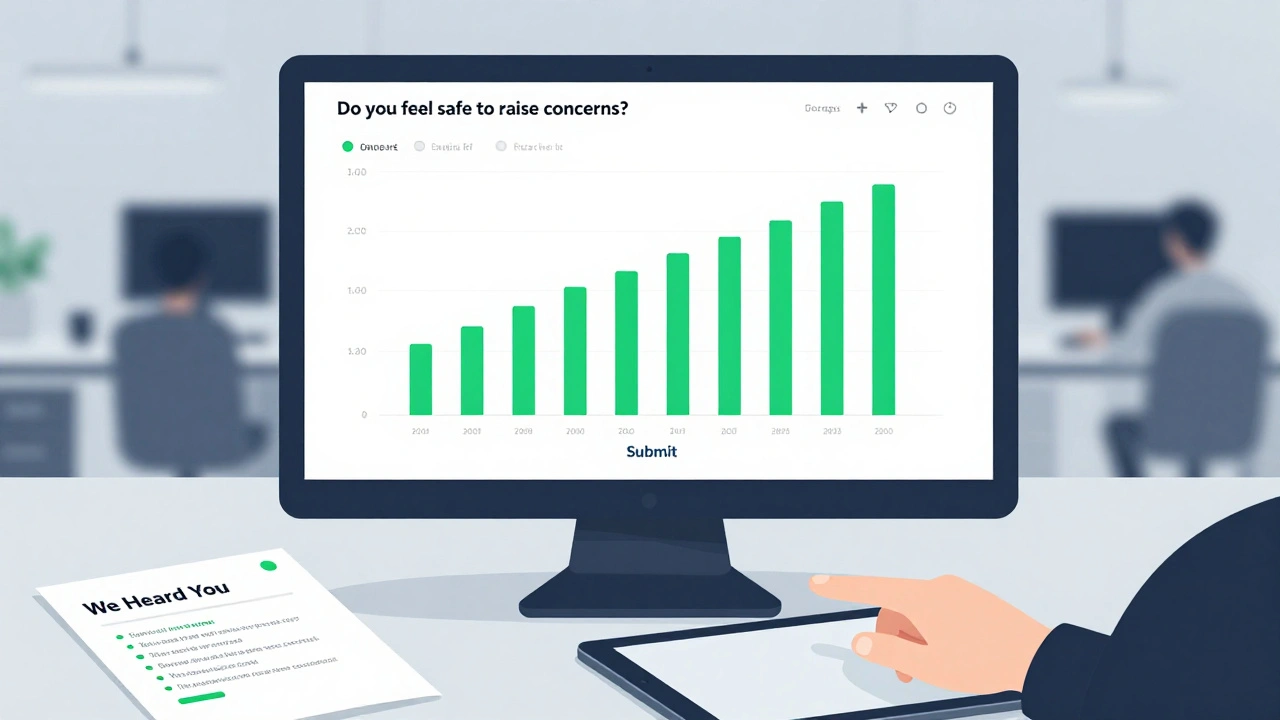
- Use anonymous feedback tools-not just once a year. Tools like Culture Amp or Officevibe let people share concerns without names. But the key is action. If you collect feedback and do nothing, trust dies. One London-based consultancy started sharing a monthly "We Heard You" email: "You said X. We did Y. Here’s why we didn’t do Z." Transparency built credibility.
- Reframe disagreement as improvement. Train teams to say, "I see it differently-can we explore why?" instead of "You’re wrong." A financial services team in Edinburgh replaced "I disagree" with "Help me understand your thinking." Conflict dropped by 45%. Productivity rose.
- Recognise vulnerability as courage. When someone speaks up with a risky idea or admits failure, say it out loud: "Thank you for saying that. That took guts." Not just in private-in front of the team. Recognition reinforces the behaviour you want to see.

What Doesn’t Work (And Why)
Many UK companies try to "fix" psychological safety with team-building retreats, trust exercises, or posters that say "Speak Up!" None of these work if the daily reality doesn’t match.
One firm in Leeds ran a "No Blame Week." Employees were told to report mistakes without fear. But the next day, the same manager publicly criticised someone for a small error. The message was clear: "Say anything you want-just don’t expect me to mean it."
Psychological safety isn’t an event. It’s a habit. It’s built in the small moments: how you respond to a question, how you handle a mistake, how you treat silence.
How to Measure It
You can’t manage what you don’t measure. Here’s how to track psychological safety in your team:
- Ask quarterly: "Do you feel safe to raise concerns without fear of negative consequences?" (Scale: 1-5)
- Track how often ideas from junior staff are implemented.
- Monitor meeting participation: Who speaks? Who stays quiet? Is it always the same people?
- Look at turnover: Are high performers leaving because they feel unheard?
A team in Cardiff improved their score from 2.8 to 4.3 on that first question in nine months. Their project delivery rate jumped 30%. That’s not magic. That’s safety.
When Psychological Safety Goes Wrong
It’s possible to confuse psychological safety with permissiveness. No, it doesn’t mean everyone can say anything they want. It means people can say hard things-respectfully, constructively, and with the goal of improving outcomes.
A team in Glasgow once misinterpreted safety as "no rules." They started interrupting each other, making sarcastic comments, and dismissing ideas too quickly. The result? Chaos. The leader had to reset: "We’re not here to be nice. We’re here to be honest-and to listen."
Psychological safety requires structure. It needs clear norms: no interruptions, no eye-rolling, no shutting down ideas before they’re fully shared.
What Happens When It Works
At a mid-sized NHS trust in Sheffield, nurses started using a simple phrase in handovers: "I’m worried about..." It replaced the old "Everything’s fine." Within a year, near-miss incidents dropped by 61%. Staff turnover fell. Morale soared.
That’s the power of candid discussion. Not because people became louder. But because they finally felt safe to be truthful.
Psychological safety isn’t about fixing people. It’s about fixing the environment. And in UK teams, that environment is still waiting for the right kind of leadership.
Can psychological safety exist in hierarchical UK organisations?
Yes-but only if leaders actively break the silence. Even in traditional organisations, managers who admit mistakes, ask for input, and respond without defensiveness create pockets of safety. It doesn’t require flattening the org chart. It requires changing how power is used.
Is psychological safety the same as employee engagement?
No. Engagement is about how motivated people feel. Psychological safety is about whether they feel safe to speak up. You can have highly engaged teams that are terrified to disagree. That’s dangerous. Safety comes first-without it, engagement is just noise.
How long does it take to build psychological safety?
It’s not a project with a deadline. You start seeing small shifts in 6-8 weeks if leaders are consistent. Real cultural change takes 6-12 months. The key is repetition: every meeting, every feedback session, every mistake handled well adds up.
What if my team is too quiet-is it psychological safety or just disengagement?
Ask them. Use anonymous surveys. Look at who speaks in meetings and who doesn’t. If the same people always talk, and others never do, it’s likely safety, not disengagement. Disengaged people don’t care. Quiet people are often scared. The fix is different.
Can remote teams have psychological safety?
Absolutely-but it’s harder. In virtual settings, silence is easier to hide. Use video. Call on quiet members by name. Create dedicated channels for anonymous feedback. Celebrate vulnerability in Slack or Teams. Remote doesn’t mean disconnected. It just means you have to work harder to make people feel seen.