
 by
by Revenue Share Deals in the UK: How to Structure and Track Partner Value
23 Dec, 2025When you’re running a business in the UK and looking to grow without hiring more staff or spending big on ads, revenue share deals can be one of the smartest moves you make. But too many companies set them up wrong - and end up paying partners for low-quality leads, losing money, or worse, damaging their brand. The problem isn’t the model. It’s how it’s structured and tracked.
What a Revenue Share Deal Actually Means in the UK
A revenue share deal isn’t just paying someone a commission. It’s giving a partner a percentage of the actual money your customer spends with you - not just the sale. That means if someone signs up for a £50/month subscription and stays for a year, you pay them 15% of £600, not £50. This keeps partners motivated to bring in customers who stick around, not just those who click and vanish.
It’s common in SaaS, financial services, subscription boxes, and online education in the UK. Companies like Monzo, Revolut, and even local fitness studios use it. The key difference from affiliate programs? Affiliates often get paid per lead or sign-up. Revenue share ties their income directly to your long-term success.
How to Structure a Fair Revenue Share Deal
There’s no one-size-fits-all percentage. Too low, and partners won’t care. Too high, and you’re giving away your profit margin. Most UK businesses start between 10% and 25%, depending on the industry and customer lifetime value.
- For high-ticket services (like £2,000/year accounting software), 15-20% is standard. Partners are doing the heavy lifting - explaining complex value, handling objections, and building trust.
- For low-cost subscriptions (like £10/month meal kits), 20-25% makes sense. You need volume, so you pay more per customer to get the traffic.
- For B2B, 10-15% is typical. Sales cycles are longer, but the clients are worth more. You can afford to pay less per sale if they stay for years.
Always cap payouts at 12 months unless you’re in a high-churn industry. You don’t want to pay a partner for a customer who’s been with you for five years. And never pay on gross revenue - always use net revenue after refunds, chargebacks, and payment processing fees. Stripe and PayPal fees can eat 3-5% of every transaction. If you pay on gross, you’re subsidizing those costs.
Track What Actually Matters - Not Just Sign-Ups
Most businesses track sign-ups. That’s a mistake. A partner who brings in 100 sign-ups but 90 cancel after 7 days is costing you money. You need to track:
- Customer retention rate by partner
- Average revenue per user (ARPU) from each partner’s traffic
- Refund and chargeback rates by source
- Time to first purchase after sign-up
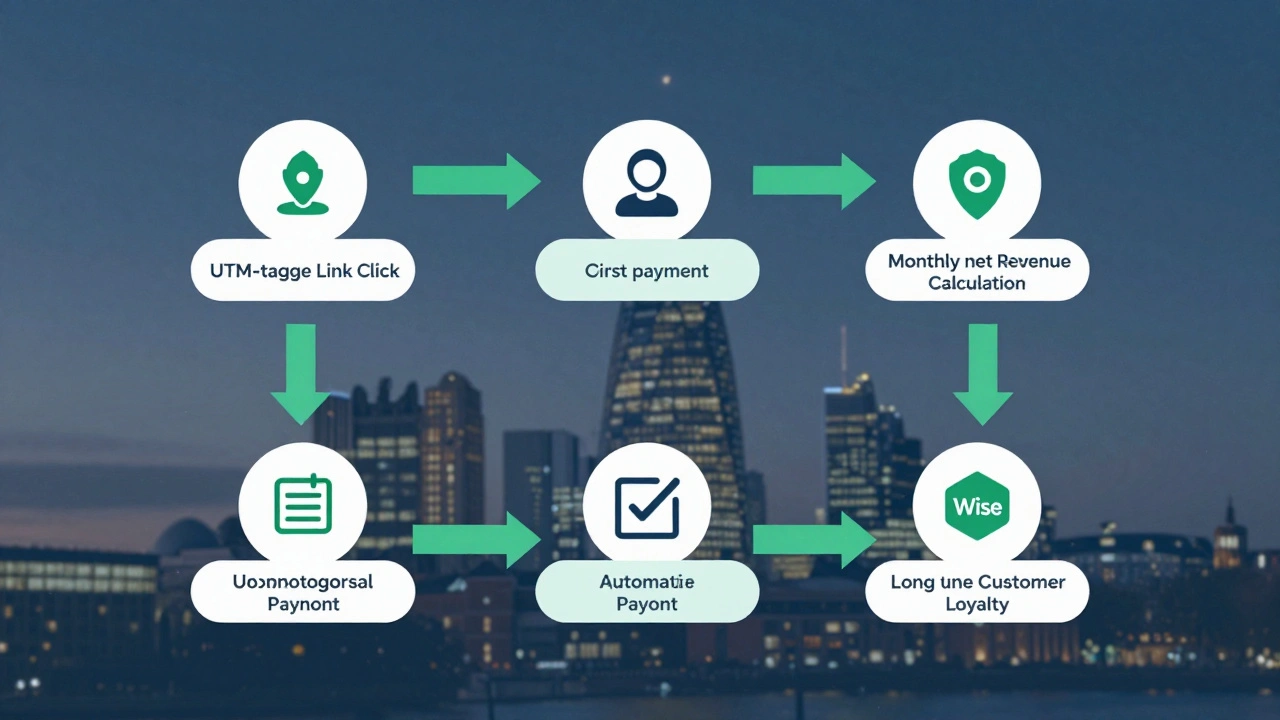
Use a UTM tagging system with unique codes for each partner. Tools like Refersion, PartnerStack, or even custom-built dashboards in Google Data Studio work well. Tag every link your partners use. Then, connect those tags to your CRM and payment system. If you use Stripe, you can add custom metadata to each customer that shows which partner referred them.
One UK-based online course platform noticed that one partner was driving 30% of sign-ups - but 78% of those customers canceled within 14 days. They dug in. Turns out, the partner was using clickbait ads promising "free certification." They cut the partnership. Their overall retention jumped 22% in two months.

Set Clear Rules - Before You Sign Anything
Don’t rely on trust. Write it down. A simple one-page agreement should include:
- Revenue share percentage (and whether it’s gross or net)
- Payment schedule (monthly, 15 days after month-end)
- Payment method (bank transfer, PayPal, Wise)
- What counts as a valid customer (must be UK-based, must complete onboarding, must not be a duplicate)
- How long the cookie lasts (30 days is standard)
- How refunds and chargebacks are handled (deducted from future payouts)
- Branding rules (can they use your logo? Can they make false claims?)
- Termination clause (30 days’ notice, no penalties)
Use a template from the UK’s British Chambers of Commerce or consult a solicitor if you’re dealing with high-value partners. A poorly written agreement can cost you more than a bad partner.
Watch Out for These Common Mistakes
Here’s what goes wrong in 8 out of 10 UK revenue share deals:
- Paying on sign-ups, not sales - Partners spam free trials and get paid even if no one pays.
- Not tracking refunds - A partner sends 100 customers, 40 charge back. You still paid them. You lost money.
- Using the same tracking link for everyone - You can’t tell who’s delivering real value.
- Forgetting tax - Partners in the UK must declare this income. If you pay over £500/year, you need to report it to HMRC under RTI. Don’t assume they’ll handle it.
- Not testing different rates - Try 15% vs. 20% with two similar partners. See what moves the needle on retention, not just sign-ups.
One fintech startup in Manchester paid 25% to every partner. They didn’t track retention. After six months, they realized their top partner in terms of sign-ups was also their biggest loss-maker. They switched to a tiered model: 20% for the first 90 days, then 10% if the customer stays. Profit per partner jumped 40%.
When to Walk Away
Not every partner is worth keeping. If a partner:
- Consistently brings in customers with high refund rates (over 25%)
- Uses misleading ads or fake testimonials
- Has no engagement beyond sending links (no content, no follow-up)
- Demands a higher cut without adding value
- it’s time to end it. You’re not just losing money. You’re risking your brand reputation. One UK health supplement brand lost 17% of its Google search ranking after a partner ran fake reviews. Google penalized them for deceptive practices. They had to rebuild their entire SEO strategy.
What Success Looks Like
Good revenue share deals don’t just grow revenue - they grow your network. A partner who brings in 10 loyal customers a month becomes a long-term advocate. They might start writing blog posts, hosting webinars, or even referring other partners.
Look for partners who care about your customers. Someone who sends you 50 people who churn in a week is noise. Someone who sends you 10 people who refer their friends and leave glowing reviews? That’s gold.
One London-based yoga studio started with one partner - a local wellness influencer. She didn’t just post Instagram stories. She hosted free live sessions, answered questions, and followed up with her audience. Within 8 months, 60% of her referrals were still active. She now gets 20% of revenue, but she’s also the studio’s most trusted voice in the community.
Revenue share isn’t about paying for clicks. It’s about building a team of people who want you to win. Structure it right, track it honestly, and you’ll turn partners into your most powerful growth engine.
How do I calculate revenue share payments accurately in the UK?
Start with your net revenue - subtract payment processing fees (Stripe, PayPal), refunds, and chargebacks. Then apply your agreed percentage. For example, if a customer pays £120, but £6 goes to fees and £10 is refunded, your net revenue is £104. At 15%, you pay £15.60. Use accounting software like QuickBooks or Xero to auto-calculate this by linking your payment processor.
Do I need to report revenue share payments to HMRC?
Yes. If you pay a UK-based partner more than £500 in a tax year, you must report those payments under Real Time Information (RTI) as part of your payroll. Even if they’re not employees, HMRC treats this as income. You don’t need to deduct tax, but you must declare the payment. Keep records for at least six years.
Can I use the same tracking link for multiple partners?
No. Using the same link makes it impossible to know who deserves credit. Always use unique UTM parameters or partner-specific URLs. Tools like Bitly, Pretty Links, or dedicated affiliate platforms let you generate custom links for each partner. Without this, you’re guessing - and that’s how partnerships fail.
What’s the difference between revenue share and affiliate marketing?
Affiliate marketing usually pays per action - a click, a sign-up, or a sale. Revenue share pays a percentage of the actual money the customer spends over time. So if a customer stays for a year, an affiliate might get £50. A revenue share partner could get £180. Revenue share rewards long-term value, not just quick wins.
How do I find the right partners for a revenue share deal in the UK?
Look for people who already talk about your niche - bloggers, YouTubers, local business groups, or even satisfied customers. Don’t chase big names. A micro-influencer with 5,000 engaged followers who genuinely love your product is better than a celebrity with 100K followers who doesn’t know your brand. Reach out personally. Offer a test deal: 15% for 3 months. See how they perform before committing long-term.