
 by
by Trading Name vs Registered Company Name in the UK: Key Differences Explained
17 Aug, 2026Imagine you run a bakery called "Sweet Tooth Bakes". On your website and social media, everyone knows you by that catchy name. But when you file your tax returns or sign a lease for your shop, the paper trail shows "John Smith Trading" or "Smith Enterprises Ltd". This gap between what customers see and what the government records is where confusion often starts. Understanding the distinction between a trading name and a registered company name is crucial for any UK business owner, whether you are just starting out or scaling up.
The core difference lies in legal identity. A registered company name is your legal fingerprint with HMRC and Companies House. It is the name under which you exist as a separate legal entity (if you are a limited company) or as a self-employed individual (if you are a sole trader). A trading name, on the other hand, is simply a brand label. It is what you choose to present to the public to make your business more memorable or appealing. You can change your trading name tomorrow without changing your legal status, but changing your registered name involves formal filings and potentially new contracts.
What Is a Trading Name?
A trading name, also known as a DBA (Doing Business As), is the name under which you conduct your day-to-day operations. For sole traders, this is particularly common because your registered name is usually just your full personal name. If you don't want to put your surname on every invoice, you adopt a trading name. For example, if your name is Sarah Jones but you sell handmade candles, you might trade as "Sarah's Candles" or "Glow & Co."
Key characteristics of a trading name include:
- No separate legal personality: The trading name does not create a new legal entity. If you sue or get sued, it is still you personally (for sole traders) or your limited company (for Ltd firms).
- Flexibility: You can switch trading names as often as you like without notifying Companies House, provided you update your customer-facing materials.
- Brand focus: It serves marketing purposes. It helps you build a brand distinct from your personal identity or corporate structure.
However, there are rules. You cannot use a trading name that is identical to an existing registered company name if it causes confusion. Also, if you are a sole trader, you must display your real name and address somewhere prominent, such as on invoices or your website footer, even if you operate under a trading name. This transparency requirement protects consumers from hidden identities.
What Is a Registered Company Name?
Your registered company name is the official name recorded at Companies House. For limited companies, this includes the suffix "Ltd" or "Limited". For sole traders, while they don't register with Companies House, their registered name for tax purposes is typically their full legal name unless they have adopted a specific business name for HMRC records.
This name carries significant legal weight. It appears on your Certificate of Incorporation, bank accounts, insurance policies, and all statutory documents. Changing this name is a formal process. You need to pass a special resolution (for Ltd companies), file form AD01 with Companies House, and notify HMRC, banks, landlords, and key suppliers. It is not a casual decision; it has financial and administrative costs.
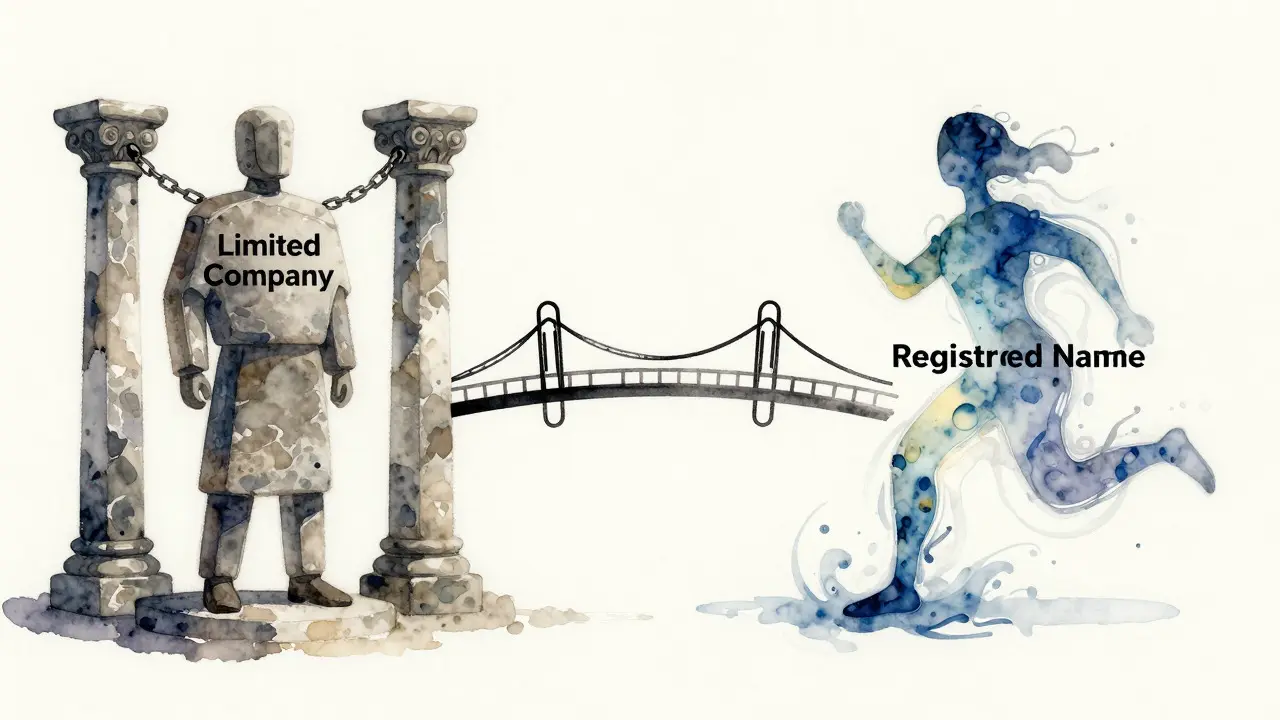
Limited Company is a type of business structure in the UK where owners have limited liability, meaning their personal assets are protected from business debts. The registered name of a limited company must end with 'Ltd' or 'Limited' and is legally distinct from its directors and shareholders.
Key Differences: Legal, Financial, and Operational
To clarify the distinctions, let's look at how these two names function in practice. The table below summarizes the critical differences that affect your daily operations and long-term strategy.
| Feature | Trading Name | Registered Company Name |
|---|---|---|
| Legal Status | No separate legal entity; alias only | Official legal identity with Companies House/HMRC |
| Change Process | Informal; update branding and inform clients | Formal; requires filing forms and board resolutions |
| Liability | Personal liability remains (sole traders) | Limited liability applies (Ltd companies) |
| Cost to Change | Low (design/printing costs) | Higher (legal fees, filing fees, rebranding) |
| Protection | No automatic trademark protection | Name reserved during incorporation, but not exclusive forever |
One major pitfall many new business owners face is assuming that registering a trading name gives them exclusive rights to it. In reality, unless you trademark the name, anyone else can technically use it, provided they aren't causing confusion with your registered company name. Conversely, having a registered company name doesn't stop others from using a similar trading name if it doesn't infringe on your trademarks. This is why understanding the boundary between the two is vital for protecting your brand equity.
When Should You Use One Over the Other?
Most businesses actually use both. Your registered name handles the back-office legalities, while your trading name handles the front-of-house branding. However, there are scenarios where one takes precedence over the other.
If you are a sole trader, you likely *must* use a trading name if you want to avoid putting your personal details on every piece of correspondence. For instance, if you are a freelance graphic designer named Alex Brown, trading as "Pixel Perfect Design" looks more professional than "Alex Brown Services". Here, the trading name is your primary customer-facing identity, while your registered name (Alex Brown) remains your legal anchor for taxes and contracts.
For limited companies, the dynamic is different. Your registered name already includes "Ltd", which signals corporate structure. You might keep your registered name as your trading name if it is strong and recognizable (e.g., "Unilever Limited"). However, if your registered name is generic or outdated, you might launch a trading name for a specific product line or service branch. For example, a large IT firm registered as "Tech Solutions Ltd" might trade as "CloudFirst" for its cloud services division. This allows them to market a specific niche without renaming the entire parent company.

Common Mistakes to Avoid
Mixing up these concepts can lead to legal headaches and lost revenue. Here are three common errors I see frequently:
- Failing to disclose the registered name: Sole traders who use a trading name often forget to list their real name and address on invoices. This violates consumer protection laws. Always ensure your legal identity is visible, even if small.
- Assuming name exclusivity: Just because you've been using a trading name for five years doesn't mean no one else can start using it. Without a trademark, your protection is weak. Check the UK Intellectual Property Office database regularly.
- Changing the registered name too lightly: Renaming a limited company disrupts banking relationships, credit history, and supplier contracts. Only do this if the strategic benefit outweighs the friction. Often, it is easier to adopt a new trading name than to rename the company itself.
How to Choose the Right Strategy for Your Business
Deciding how to structure your naming depends on your business model and growth plans. If you are just starting out as a sole trader, pick a memorable trading name that reflects your services. Keep your registered name simple (your legal name) to minimize administrative complexity. As you grow, consider incorporating. Once you become a limited company, you will have a registered name ending in "Ltd". At this point, evaluate if your current trading name still fits. If yes, continue using it. If no, you can switch your trading name without touching your registered name.
Remember, the goal is clarity. Customers should know who they are buying from, and the government should know who is liable for taxes. By keeping these two names distinct but aligned, you protect your legal position while building a strong brand. Regularly review your naming strategy as your business evolves. What works for a solo freelancer may not work for a multi-employee corporation. Stay flexible, stay compliant, and always prioritize the clarity of your legal identity behind your creative branding.
Do I need to register my trading name with Companies House?
No. Unlike your registered company name, a trading name does not require registration with Companies House. It is simply an alias you use for business operations. However, you must ensure it does not mislead customers or infringe on existing trademarks.
Can I have multiple trading names for one company?
Yes. A single registered company can operate under several different trading names, often used for different product lines, subsidiaries, or regional markets. Each trading name operates under the umbrella of the same legal entity, sharing the same liabilities and assets.
What happens if I change my trading name?
You should notify your customers, suppliers, and any partners who interact with you under that name. Update your website, social media profiles, invoices, and signage. There is no legal filing required, but failing to communicate the change can lead to confusion and lost payments.
Is a trading name the same as a trademark?
No. A trading name is just a name you use. A trademark is a legal right granted by the UK Intellectual Property Office that gives you exclusive rights to use that name/logo in a specific industry. You can trademark a trading name to gain stronger legal protection against competitors.
Do limited companies need a trading name?
Not necessarily. Many limited companies use their registered name (minus the 'Ltd') as their trading name. However, if the registered name is too technical or generic, they may adopt a friendlier trading name for marketing purposes. The choice depends on brand strategy.