 by
by Transit Procedures and T1 for UK Trade: Moving Goods Under Customs Control
3 Dec, 2025When you’re shipping goods from the EU to the UK-or vice versa-your cargo doesn’t just hop on a truck and cross the border. It goes through a legal process called T1 transit procedure. This isn’t paperwork for the sake of it. It’s the system that lets goods move across borders without paying duties upfront, as long as they stay under customs control. If you skip this step or mess it up, your shipment gets stuck, fined, or even seized.
What Is the T1 Transit Procedure?
The T1 is a customs document used to move goods under customs control from one point to another within the EU, UK, or between them. It’s not a form you fill out once and forget. It’s a tracking system that follows your cargo from departure to destination, ensuring taxes and duties are only paid when the goods reach their final destination-not at every border crossing.
Think of it like a sealed envelope. The goods inside are under customs supervision. The envelope can’t be opened until it gets to the approved destination. If someone tries to open it early, alarms go off. That’s what happens if you divert your shipment without declaring it-you trigger a customs violation.
The T1 was originally an EU system, but after Brexit, the UK kept using it for goods moving between Great Britain and the EU. Northern Ireland has different rules under the Windsor Framework, but for most traders, T1 remains the standard for land and sea transit between GB and the EU.
When Do You Need a T1?
You need a T1 when you’re moving non-UK goods through the UK or into the EU without paying VAT or duties right away. Here are the most common scenarios:
- Shipping goods from Germany to Ireland via the UK
- Transporting electronics from France to Scotland
- Moving machinery from Poland to Wales
You don’t need a T1 if:
- The goods are already in the UK and staying there (you’ll use a customs declaration instead)
- The goods are UK-origin and going to the EU (they’re not under customs control)
- You’re using the Common Transit Convention (CTC) for land transport through non-EU countries like Switzerland or Norway
It’s easy to get confused. If your goods aren’t from the UK and you’re just passing through, you’re likely under customs control-and that means T1.
How the T1 Process Works Step by Step
Here’s how it actually works on the ground:
- Prepare the goods - Make sure they’re properly packed, labeled, and match the description on your commercial invoice.
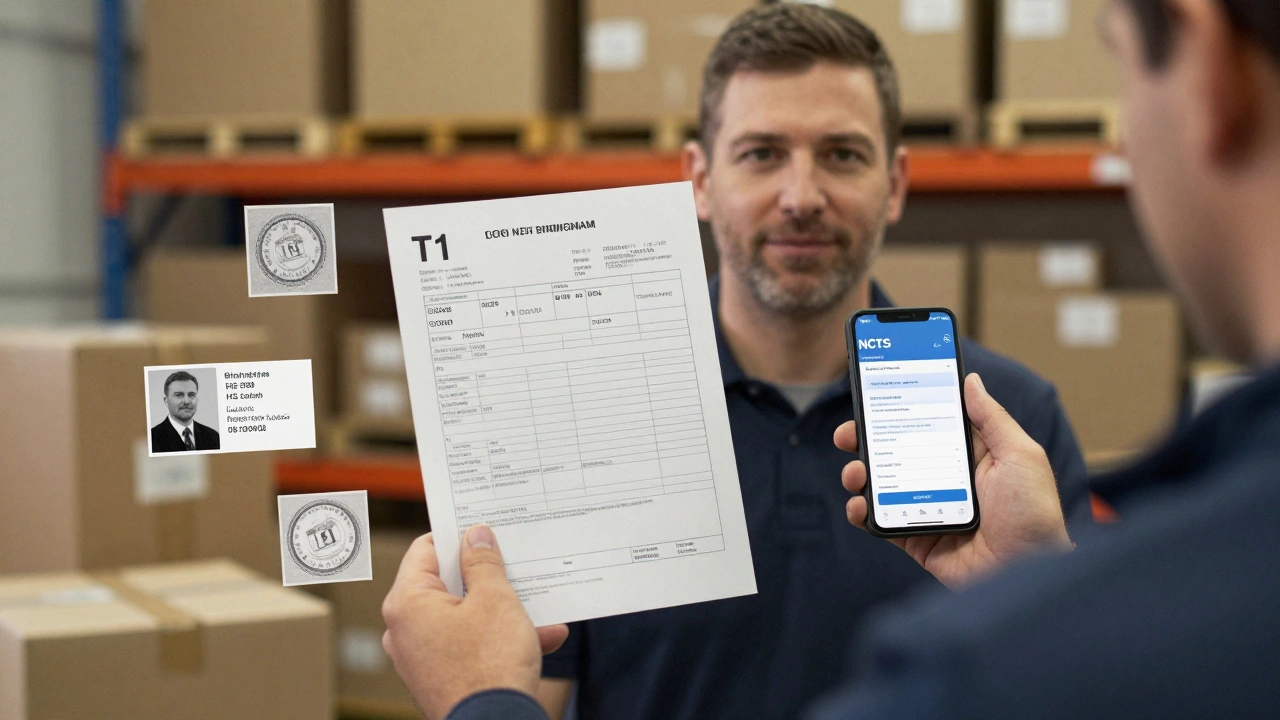
- Submit the T1 declaration - Your customs agent or freight forwarder files the T1 electronically through the New Computerised Transit System (NCTS). You need your EORI number, carrier details, and a full goods description with HS codes.
- Customs approves the T1 - Once approved, you get a unique T1 reference number. This is your tracking ID.
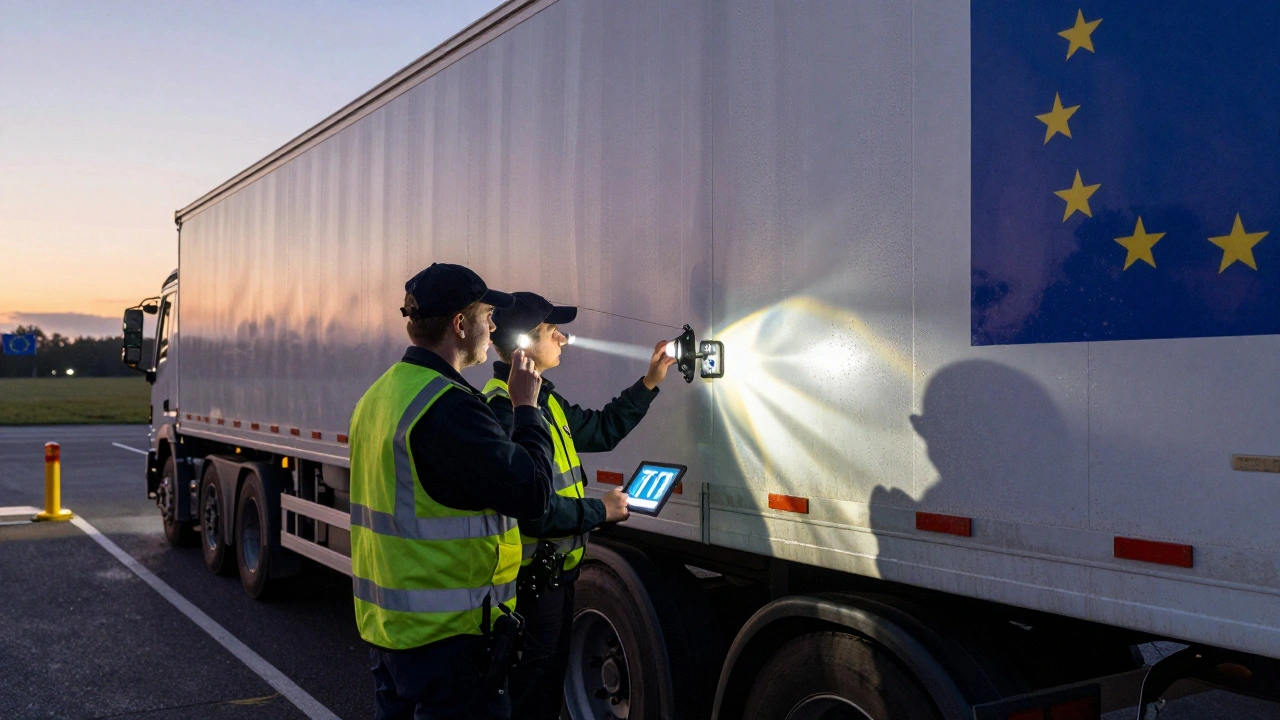
- Goods are sealed - The vehicle is physically sealed by customs at the point of departure. No one can open it without authorization.
- Transit begins - The truck moves. GPS trackers and border checkpoints monitor its route.
- Destination customs clears it - At the final point, customs checks the seal, matches the goods to the T1, and either releases them (if duties are paid) or returns them if something’s wrong.
Every step is recorded. If the truck stops in Belgium for a coffee break and the seal is broken, customs gets an alert. That’s not a delay-it’s a red flag.

Who Can File a T1?
Only authorized persons can submit a T1. That usually means:
- A licensed customs agent
- A registered freight forwarder
- A trader with an AEO (Authorized Economic Operator) status
Most small businesses don’t file T1s themselves. They hire a logistics partner who handles it. But if you’re doing this regularly, getting AEO status saves time. AEO-certified traders get faster processing, fewer checks, and priority at borders.
Even if you’re not AEO, your carrier must be. If your trucking company doesn’t have the right permissions, your T1 won’t be accepted. Always ask: “Do you handle T1 declarations?” before signing a contract.
Common Mistakes That Delay or Block Your Shipment
Here’s what goes wrong more often than you’d think:
- Wrong HS code - A misclassified item can trigger a full inspection. A “plastic toy” coded as “industrial part” looks suspicious.
- Missing or incorrect EORI - If your EORI number is wrong, the system rejects the T1. UK EORI starts with GB; EU EORI starts with EU.
- Unsealed vehicle - Customs won’t accept a T1 if the trailer isn’t physically sealed. No seal? No transit.
- Delayed declaration - Submitting the T1 too late means the truck waits at the border. Some ports charge £100+ per hour for detention.
- Incorrect destination - If the T1 says “London” but the truck goes to “Manchester,” customs flags it as a diversion.
One company I worked with lost €12,000 in perishable goods because the T1 listed the wrong port. The goods rotted before customs cleared them. That’s not rare.
T1 vs. Other Transit Systems
There are other transit systems, but T1 is the most common for UK-EU trade:
| System | Used For | Scope | Key Difference |
|---|---|---|---|
| T1 | Goods moving between EU and UK | EU, UK, EFTA | Requires physical seal; electronic tracking |
| T2 | Goods moving within the EU | EU only | Only for EU-origin goods; no UK involvement |
| CTC | Land transit through non-EU countries | EU, UK, Switzerland, Norway, etc. | Can be used for routes through Turkey or Balkans |
| ATAC | Maritime transit | EU and UK ports | Used for sea freight; less common than T1 |
If you’re shipping by sea from Rotterdam to Southampton, T1 still applies. ATAC is rarely used unless you’re dealing with bulk cargo or specialized maritime routes.
What Happens If You Get It Wrong?
Customs penalties are serious. Here’s what can happen:
- Detention - Your truck sits at the border for days. You pay storage fees.
- Fines - Up to £1,000 per violation, plus duty arrears.
- Seizure - If customs thinks you’re smuggling, they can take the whole load.
- Loss of AEO status - One major error can revoke your trusted trader status.
In 2024, HMRC reported over 8,000 T1-related penalties across the UK. Most were avoidable. The top reason? Incomplete documentation.
It’s not just money. It’s time. A delayed shipment can break a production line, cause a retail stockout, or ruin a contract. One food importer in Wales lost a £50,000 contract because their T1 was rejected at Dover. The buyer switched suppliers.
How to Avoid Problems: Best Practices
Here’s what works in real life:
- Always double-check your EORI - UK: GB + 12 digits. EU: country code + 12 digits.
- Use a customs broker - Even if you’re experienced, a pro reduces risk.
- File early - Submit the T1 at least 24 hours before departure.
- Verify the seal - Take a photo of the seal number before the truck leaves.
- Track your T1 - Use the NCTS portal to see real-time status. If it shows “pending,” don’t assume it’s approved.
- Train your drivers - They need to know not to open the trailer, even if asked by a local official.
One logistics firm in Birmingham started requiring drivers to send a photo of the seal and T1 reference number via WhatsApp before leaving the depot. Their rejection rate dropped by 78% in six months.
What’s Next for T1?
The UK is moving toward digital customs systems. By 2026, paper T1s will be gone. All declarations must be electronic. The NCTS system is being upgraded to handle more data, including real-time GPS tracking and AI-based risk scoring.
Also, the UK-EU Trade and Cooperation Agreement is under review. There’s talk of simplifying transit for small consignments under £1,000. But for now, T1 remains mandatory for nearly all cross-border shipments.
If you’re trading between the UK and EU, treat T1 like a license plate for your cargo. No T1? No movement. Get it right, and your goods flow. Get it wrong, and everything stops.
Do I need a T1 for goods moving from Northern Ireland to the EU?
No. Northern Ireland follows different rules under the Windsor Framework. Goods moving from Northern Ireland to the EU are treated as moving within the EU customs territory. You use EU transit systems like T2, not T1. T1 is only for movements between Great Britain and the EU.
Can I use the same T1 for multiple shipments?
No. Each T1 declaration is tied to one specific shipment with one set of goods, one vehicle, and one route. You can’t combine multiple pallets or trucks under one T1. Each needs its own unique reference number.
How long is a T1 valid for?
A T1 is valid for up to 10 days from the date of departure, unless customs grants an extension. Most shipments are cleared within 3-5 days. If your goods are delayed due to weather or strikes, contact customs immediately to avoid penalties.
What if my goods are damaged during transit?
If damage occurs, you must report it to customs at the next control point. You’ll need proof-photos, inspection reports, or a carrier’s statement. Customs may allow a partial duty waiver if the damage is confirmed. Never try to hide it. That’s considered fraud.
Can I use a T1 for air freight?
Technically yes, but it’s rarely done. Air shipments usually use different customs procedures like the Air Waybill with customs declaration. T1 is designed for road and sea transit. If you’re shipping by air, ask your carrier which system they use.