 by
by UK Customer Onboarding Email Sequences: Templates & Timelines
17 Aug, 2026Most businesses send a welcome email and then go silent. For UK customers is a demographic that values clarity, privacy, and respect for their time. If your onboarding process feels like a generic blast from a US tech giant, you risk losing them before they even realize what you sell. The difference between a churned lead and a loyal advocate often lies in the first 14 days of communication.
Getting this right requires more than just nice copy; it demands a strategic rhythm that aligns with local expectations. You need to balance value delivery with compliance, ensuring every touchpoint feels personal rather than pushy. This guide breaks down the exact structure, timing, and content needed to turn new sign-ups into long-term users.
Why Standard Playbooks Fail in the UK Market
Many marketers assume that if an email works in New York, it will work in London. It usually doesn't. GDPR is the General Data Protection Regulation, which sets strict rules for handling personal data in Europe and the UK. While not directly about email copy, it influences how aggressively you can segment and personalize without feeling invasive. UK consumers are highly sensitive to data usage. If your subject line promises "Personalized Insights" but the body looks like a template, trust drops instantly.
Culturally, British business communication tends to be understated. Exclamation marks? Use sparingly. All-caps headers? Avoid entirely. The tone should be helpful, concise, and respectful. Think of it as a knowledgeable friend giving advice, not a salesperson hitting a quota. This subtle shift in voice reduces unsubscribe rates significantly compared to high-energy approaches.
The Anatomy of a High-Converting Sequence
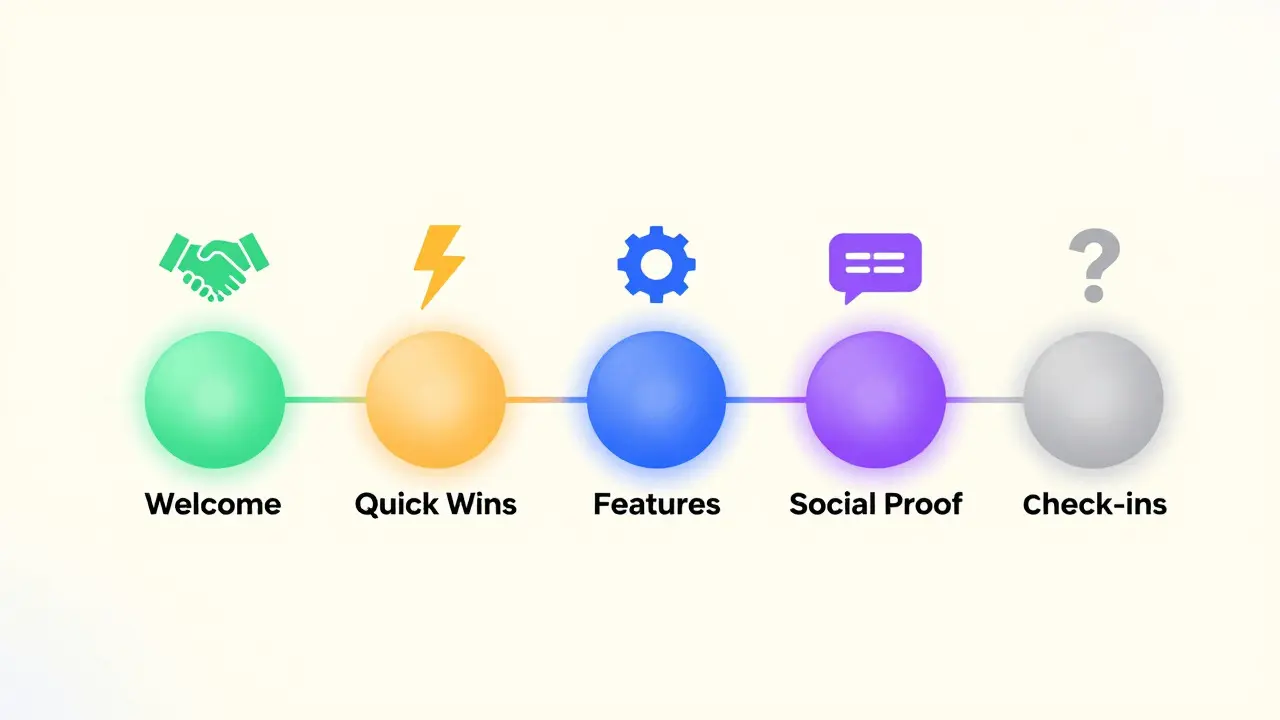
A robust onboarding sequence typically consists of four to six emails sent over two weeks. The goal isn't to sell immediately; it's to achieve "Aha!" moments where the user sees tangible value. Here is the standard architecture that drives engagement:
- Welcome & Expectations (Day 0): Immediate confirmation. Set the stage for what comes next.
- Quick Win (Day 1-2): Guide them to one specific, easy task that delivers immediate value.
- Feature Deep Dive (Day 3-5): Introduce core features relevant to their use case.
- Social Proof (Day 7): Show case studies or testimonials from similar UK-based users.
- Objection Handling (Day 10): Address common fears or questions proactively.
- Soft CTA / Check-in (Day 14): Ask for feedback or offer help, rather than a hard sell.
This pacing respects the user's attention span. Sending five emails in one day overwhelms them. Waiting three weeks loses momentum. The 14-day window captures the peak curiosity period while allowing enough space for the product to integrate into their workflow.
Detailed Templates and Copy Guidelines
Don't just copy-paste these templates. Adapt the bracketed sections to fit your brand voice, but keep the structural logic intact.
Email 1: The Welcome (Day 0)
Subject: Welcome to [Product Name] - Let’s get started
Preview Text: Here’s what to expect in the next few days.
Body:
Hi [First Name],
You’re in! We’re glad you chose [Product Name]. Over the next two weeks, we’ll help you set up your account and unlock the features that matter most to you.
No spam, no pressure. Just practical tips to help you succeed.
[Button: Complete Your Profile]
Best,
The [Company] Team
Email 2: The Quick Win (Day 2)
Subject: One small step to save you hours
Preview Text: Try this feature today.
Body:
Hi [First Name],
Did you know you can automate [Specific Task] with just two clicks? Most users find this saves them around 30 minutes a week.
Here’s a quick video showing exactly how:
[Link to Video]
Give it a try now - it takes less than 5 minutes.
[Button: Automate My Workflow]
Cheers,
[Sender Name]
Email 3: Feature Deep Dive (Day 5)
Subject: How [Similar Company] uses [Product Name]
Preview Text: See real results from real users.
Body:
Hi [First Name],
Curious how other teams handle [Pain Point]?
We recently helped [Case Study Company], based in Manchester, reduce their reporting time by 40%. They used [Feature X] to streamline their data flow.
Read the full story here:
[Link to Case Study]
Want to see how it could work for you? We’ve put together a guide specifically for [Industry/Role].
[Button: Read the Guide]
Regards,
[Sender Name]
Email 4: Objection Handling (Day 10)
Subject: Questions about security? We have answers.
Preview Text: Your data stays yours.
Body:
Hi [First Name],
We know switching tools can raise questions about data privacy and integration.
Rest assured, [Product Name] is fully GDPR compliant and offers end-to-end encryption. Plus, our API integrates seamlessly with [Common Tool A] and [Common Tool B].
Still unsure? Our support team is available via live chat during UK business hours (9am-5pm GMT).
[Button: Chat with Support]
Kind regards,
[Sender Name]
Email 5: The Check-In (Day 14)
Subject: How’s it going?
Preview Text: We’d love your honest feedback.
Body:
Hi [First Name],
It’s been two weeks since you joined. How are you finding [Product Name]?
If everything is working well, great! If something feels off, let us know. We’re always tweaking things based on user feedback.
Takes 30 seconds to answer:
[Link to Survey]
Thanks for being part of the community.
Best,
[Sender Name]
Timing and Frequency Best Practices
When should you actually send these? UK business hours run from roughly 8 AM to 6 PM GMT. However, open rates for B2B onboarding emails tend to peak between 10 AM and 12 PM. This is when people have settled into their day but haven’t hit the afternoon slump yet.
Avoid sending on Fridays after 2 PM. By then, focus shifts to weekend plans, and click-through rates drop sharply. Monday mornings are also tricky; inboxes are flooded, and your message might get buried. Tuesday through Thursday offer the safest window for consistent engagement.
| Day | Recommended Time (GMT) | Reasoning |
|---|---|---|
| Monday | 10:00 AM - 11:00 AM | Inbox is busy; wait until mid-morning for better visibility. |
| Tuesday | 10:00 AM - 12:00 PM | Peak productivity hours; highest open rates. |
| Wednesday | 10:00 AM - 12:00 PM | Consistent engagement; ideal for deeper content. |
| Thursday | 10:00 AM - 12:00 PM | Last good chance before weekend mindset sets in. |
| Friday | 9:00 AM - 11:00 AM | Send early only; avoid afternoon sends. |
Compliance and Personalization Rules
Under UK GDPR, you must ensure consent for marketing communications. For transactional onboarding emails (like account setup), consent is implied by the action of signing up. However, once you move into promotional territory (like upsells in later stages), double opt-in or clear preference management is crucial.
Personalization goes beyond using the first name. Segment your audience based on their role or industry at signup. A developer cares about API documentation; a marketer cares about campaign analytics. Tailoring the "Quick Win" email to their specific persona increases completion rates by up to 20%. Use dynamic content blocks to swap out examples based on these segments.
Measuring Success Beyond Open Rates
Open rates are declining globally due to Apple Mail Privacy Protection. Don't rely on them as your primary KPI. Instead, focus on behavioral metrics:
- Click-Through Rate (CTR): Did they click the button? This indicates intent.
- Action Completion: Did they finish the profile setup or run the first report?
- Time to Value: How quickly did they reach their first "Aha!" moment?
- Unsubscribe Rate: Should stay below 0.5% for onboarding sequences.
If your CTR is low but action completion is high, your email copy might be weak, but the product is strong. Fix the copy. If both are low, your onboarding journey is confusing. Simplify the steps.
Frequently Asked Questions
How many emails should be in an onboarding sequence?
For most B2B products, 4 to 6 emails over 14 days is optimal. More than 6 risks fatigue; fewer than 4 may not provide enough guidance to drive adoption. Adjust based on product complexity-complex enterprise software may need 8-10 emails over 30 days.
What is the best time to send onboarding emails in the UK?
Between 10 AM and 12 PM GMT on Tuesdays, Wednesdays, or Thursdays. These times align with peak business productivity and avoid the Monday inbox rush and Friday afternoon distraction.
Do I need separate consent for onboarding emails under UK GDPR?
Transactional emails required for service delivery (like account activation) do not require explicit marketing consent. However, if you include promotional content or cross-sell opportunities, ensure your privacy policy clearly states this and provide an easy way to manage preferences.
How do I personalize emails for different UK industries?
Use dynamic content blocks based on the user's selected industry or role during signup. For example, show manufacturing-specific case studies to factory managers and retail-focused tips to shop owners. This relevance significantly boosts engagement.
What metrics should I track for onboarding success?
Focus on Click-Through Rate (CTR), Action Completion Rate, and Time to Value. Unsubscribe rate should remain below 0.5%. Open rates are less reliable due to privacy changes, so prioritize behavioral data over vanity metrics.