
 by
by UK Privacy Policies: GDPR-Compliant Templates and Guidance for 2026
3 Oct, 2026Imagine getting a fine from the Information Commissioner's Office (ICO) because your website footer had a typo in its privacy link. It sounds extreme, but it happens. In the UK, GDPR is not just a suggestion; it is the law of the land, specifically enforced through the UK GDPR and the Data Protection Act 2018. If you run a business that touches personal data-which means almost every business-you need a privacy policy that actually works.
Most templates found online are generic garbage. They copy-paste legal jargon without considering who you are or what you do with user data. A cookie-cutter approach leaves you exposed. You need a document that reflects your specific data flows, explains them in plain English, and meets the strict transparency requirements of the ICO. This guide breaks down exactly how to build a compliant UK privacy policy, avoiding the common traps that catch small businesses off guard.
Key Takeaways
- Plain English is mandatory: The UK GDPR requires information to be concise, transparent, intelligible, and easily accessible. Legalese fails this test.
- Specificity beats generality: List every single third-party service you use (like Mailchimp or Stripe) and why you share data with them.
- International transfers matter: If your data goes outside the UK (even to US servers), you must address the 'adequacy regulations' or standard contractual clauses.
- Retention periods are required: You cannot say "we keep data indefinitely." You must state how long you keep it and why.
- User rights are active duties: Your policy must explain how users can exercise their right to access, erase, or correct their data.
Why Generic Templates Fail UK Businesses
You might think downloading a free PDF and swapping out your company name is enough. It isn't. The core principle of Data Protection by Design means your policy must match your actual operations. If your template says you only store data in the UK, but you use AWS servers located in Virginia, you are lying to your customers. That lie creates liability.
The ICO has been clear in recent enforcement actions: vague statements like "we may share data with partners" are insufficient. You need to name those partners. Furthermore, many older templates reference the EU GDPR directly. While similar, the UK version has distinct nuances, especially regarding international data transfers post-Brexit. Using an outdated EU-centric template ignores the specific mechanisms required for UK-to-US data flows under the current adequacy regulations.
Essential Components of a Compliant Policy
A robust privacy notice isn't just a list of rules; it's a communication tool. It needs to answer five fundamental questions for the user: Who are we? What do we collect? Why do we collect it? Who else sees it? And what can you do about it?
First, identify yourself clearly. Include your full legal entity name, contact details, and, if applicable, your Data Protection Officer's contact info. Next, detail the categories of personal data. Don't just say "personal data." Specify "email addresses, billing history, IP addresses, and job titles." Then, map each data type to a lawful basis for processing. Are you relying on consent? Contractual necessity? Legitimate interests? You must state which one applies to which activity.
| Lawful Basis | When to Use It | Example Scenario |
|---|---|---|
| Consent | Voluntary, specific, informed permission. | Sending marketing newsletters after opt-in. |
| Contract | Necessary to fulfill a contract. | Processing payment details to deliver goods. |
| Legal Obligation | Required by law. | Keeping tax records for HMRC. |
| Vital Interests | Life-or-death situations. | Medical emergencies involving health data. |
| Public Task | Official functions of public authorities. | Council services managing housing data. |
| Legitimate Interests | Balanced against individual rights. | Fraud prevention or network security. |
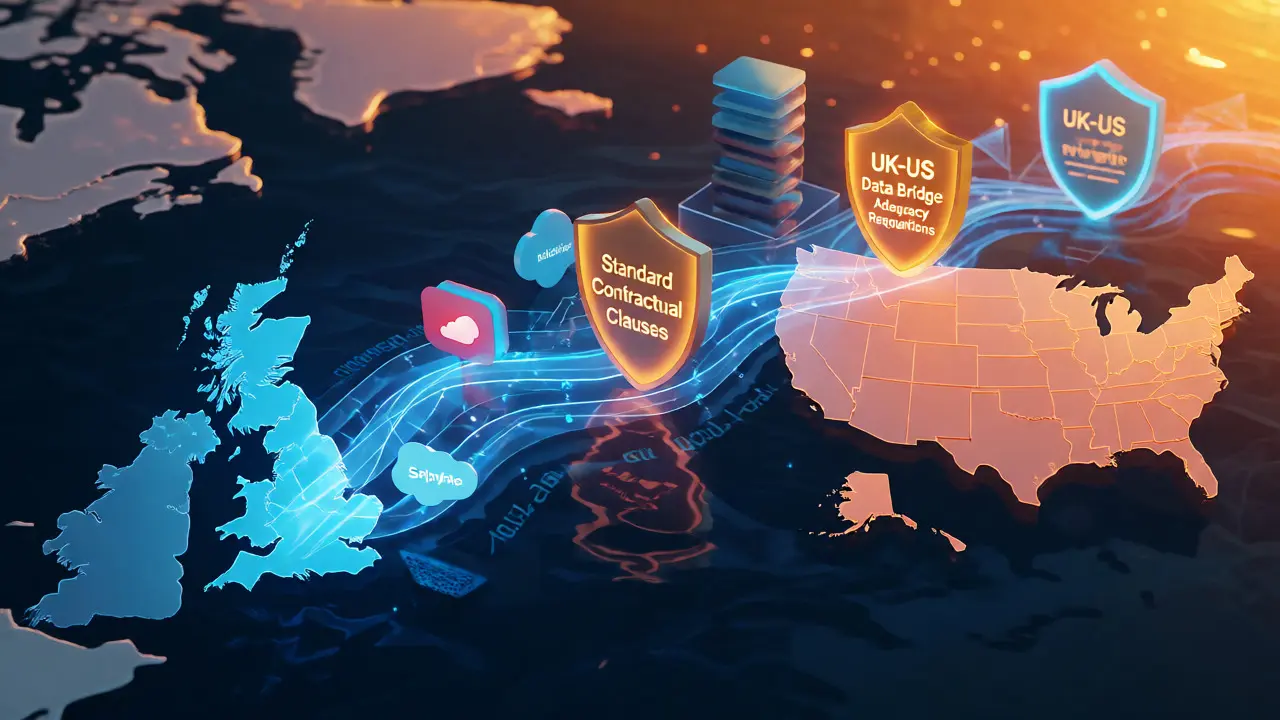
Handling International Data Transfers
This is where most UK businesses trip up. Since Brexit, the UK treats data leaving the country differently than the EU does. If you send personal data to a country not deemed "adequate" by the UK Secretary of State, you need safeguards. The US is now considered adequate under the UK-US Data Bridge (formerly the EU-US Privacy Shield successor), but this only applies to companies registered with the Department of Commerce's Data Privacy Framework.
If your vendor isn't certified, you likely need Standard Contractual Clauses (SCCs) adapted for the UK context. Check your tech stack. Do you use HubSpot? Salesforce? Google Analytics? Each has specific transfer mechanisms. Your privacy policy must explicitly mention these transfers. For example: "We transfer your email address to Mailchimp, a US-based provider, under the UK-US Data Bridge adequacy regulations." Vagueness here invites regulatory scrutiny.
Drafting Your Own Section-by-Section Guide
Start with the introduction. Keep it friendly. Explain that you respect their privacy and want them to understand how you handle their info. Then, move to the collection section. Break it down by source: data they give you (forms), data collected automatically (cookies/logs), and data from third parties (lead generation agencies).
Next, tackle retention. This is often overlooked. If you delete customer records seven years after the last transaction due to tax laws, say so. If you keep newsletter subscribers until they unsubscribe, say that too. Specificity builds trust. Then, list user rights. Under the UK GDPR, individuals have the right to access, rectify, erase, restrict processing, object to processing, and data portability. Provide a direct email address or web form for these requests. Don't make them hunt for it.
Finally, include a complaints procedure. Tell them they can complain to the ICO if they feel their rights were violated. Including this shows confidence in your practices and transparency.

Common Pitfalls to Avoid
One major mistake is burying key information. If your policy is 4,000 words of dense text, nobody reads it. Use headings, bullet points, and short paragraphs. Another error is failing to update the policy when your tech stack changes. Did you add a new chatbot? Update the policy. Did you start using a new CRM? Update the policy. Static documents become non-compliant quickly.
Also, beware of "legitimate interests" overuse. Many businesses claim legitimate interest for everything to avoid asking for consent. But if you're sending unsolicited marketing emails to existing customers, you might rely on soft opt-in rules instead. Misclassifying your lawful basis invalidates your processing. Conduct a simple Legitimate Interest Assessment (LIA) if you choose this route, and keep the documentation handy.
Implementation and Maintenance
Once drafted, place the link prominently. The footer is standard, but also link it near any sign-up forms or checkout pages. Accessibility matters too-ensure the text size is readable and contrast is sufficient for visually impaired users.
Review your policy annually. Set a calendar reminder for October each year. During the review, audit your data flows again. Have you added new vendors? Changed server locations? Altered marketing strategies? Adjust the text accordingly. Keep a version history. If the ICO ever asks, showing a timeline of updates demonstrates good faith and ongoing compliance efforts.
Do I need a separate cookie policy in the UK?
While you can combine them, a separate cookie policy is often clearer. However, under UK GDPR and PECR regulations, you must obtain explicit consent for non-essential cookies before setting them. Your privacy policy should reference how cookies fit into your broader data handling strategy.
What happens if my privacy policy is non-compliant?
The ICO can issue enforcement notices requiring you to change your practices. In severe cases, fines can reach £17.5 million or 4% of global annual turnover, whichever is higher. Even smaller breaches can lead to reputational damage and loss of customer trust.
Does the UK GDPR apply if I'm based in the US but sell to UK customers?
Yes. If you offer goods or services to people in the UK, or monitor their behavior (like tracking website visits), you fall under the extraterritorial scope of the UK GDPR. You must comply regardless of your physical location.
How long should I keep personal data?
There is no single answer. It depends on the purpose. Financial records typically require 6-7 years for tax purposes. Customer support tickets might be kept for 2-3 years. Always define a specific period or criteria for deletion in your policy.
Can I use AI tools to write my privacy policy?
AI can help draft the structure and language, but it cannot know your specific data flows. You must manually input your vendors, data types, and retention periods. Never publish an AI-generated policy without rigorous human review and legal verification.